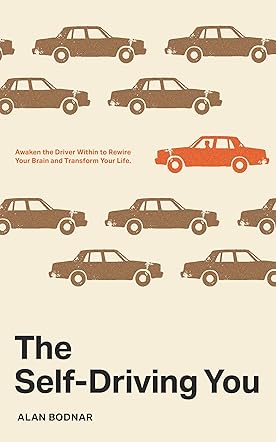

















The Self-Driving You

Awaken the Driver Within to Rewire Your Brain and Transform Your Life

Non-Fiction - Self Help
Kindle Edition
Reviewed on 05/31/2026
Buy on Amazon

This author participates in the Readers' Favorite Free Book Program, which is open to all readers and is completely free. The author will provide you with a free copy of their book in exchange for an honest review. You and the author will discuss what sites you will post your review to and what kind of copy of the book you would like to receive (eBook, PDF, Word, paperback, etc.). To begin, click the purple email icon to send this author a private email.

This author participates in the Readers' Favorite Book Review Exchange Program, which is open to all authors and is completely free. Simply put, you agree to provide an honest review an author's book in exchange for the author doing the same for you. What sites your reviews are posted on (B&N, Amazon, etc.) and whether you send digital (eBook, PDF, Word, etc.) or hard copies of your books to each other for review is up to you. To begin, click the purple email icon to send this author a private email, and be sure to describe your book or include a link to your Readers' Favorite review page or Amazon page.

This author participates in the Readers' Favorite Book Donation Program, which was created to help nonprofit and charitable organizations (schools, libraries, convalescent homes, soldier donation programs, etc.) by providing them with free books and to help authors garner more exposure for their work. This author is willing to donate free copies of their book in exchange for reviews (if circumstances allow) and the knowledge that their book is being read and enjoyed. To begin, click the purple email icon to send this author a private email. Be sure to tell the author who you are, what organization you are with, how many books you need, how they will be used, and the number of reviews, if any, you would be able to provide.

    Book Review

Reviewed by Stewart Brian for Readers' Favorite

The Self-Driving You by Alan Bodnar is a well-written self-help guide to awaken the driver within and a framework to explore the human vehicle through science and how we can intentionally rewire our vehicle for success. This book is divided into two parts, where Alan begins by establishing a bridge between self-driving cars and self-driving human vehicles. Similar to the artificial network in a level 4-automation car, the human body is controlled by the peripheral nervous system, which is connected to the brain and spinal cord. Alan extensively discusses the brain basics, the self-driving survival, and the intuitive circuits, among others. The second part focuses on understanding human biological networks, artificial networks, and human potential, as well as achieving mastery.

This is a powerful book that changed my perspective about how the brain functions with respect to the formation of behaviors and habits. The stories of other people who achieved success by deliberately practicing for 10,000 hours inspired me. I commend the author for the depth of research and references, which further authenticated the information. The chapter that discussed tuning mastery appealed to me the most. Beyond the numerous lessons, this book offered me tools to rewire my thoughts and mind to break addictions or bad habits. The writing is well-paced, organized, and easy to comprehend. Themes featured include self-awareness, science, mindfulness, intentional living, and more. I recommend The Self-Driving You by Alan Bodnar to any reader seeking personal development.

Pikasho Deka

Self-driving automated vehicles have become increasingly common nowadays. In The Self-Driving You, Alan Bodnar draws parallels between self-driving automations and the way the human brain works. You must strike a balance between running on autopilot and having the awareness to still be in control of your life, with the sweet spot somewhere near Level 3 automation. This book explains how we often find ourselves as the secondary driver of an automated system. In our lives, we form patterns from experiences that help us respond to situations as we navigate our environments. The book further delves into the nonconscious self-driving system and its responses. Learn how to set goals and measure success, as our brains have mechanical inputs and outputs much like an artificial network.

I found The Self-Driving You to be a thought-provoking guide. Alan Bodnar uses the self-driving metaphor to help readers learn how to form new patterns that lead them toward transformation and fulfillment. For example, this book explores how we can rewire our own brain networks into executive driver circuits that make us supervisors of our lives, much like a Level 4 high-automation system. Reading this book will help you understand your own brain network and rewire your self-driving system. So you no longer have to run on autopilot and can take control of your life. I liked how Bodnar makes the comparison between human and artificial networks and demonstrates how each of them works and learns. Overall, this self-help guide is unlike anything I've read before. The author does a wonderful job of explaining somewhat complex concepts in an engaging and accessible writing style. This book will appeal to a wide range of readers.

Leonard Smuts

As autonomous vehicles evolve, Alan Bodnar has identified many similarities between their style of automation and human behavior. He asserts that most humans function on autopilot. We do not have to think about breathing, our heartbeat, or our digestive system. The danger is that we also accept daily routines as built-in functions without question. We risk losing control over our fate and being unable to reach our potential. He shares his research in The Self-Driving You. Self-driving vehicles have sensors that feed data to a computer that takes appropriate action in line with its programming, learning as it goes. As humans, we alternate between the conscious and what the author calls the nonconscious, drawing on learned patterns for guidance. We are pre-wired from the outset with functions such as survival mechanisms, and we add patterns gained through experience as we age. Some of these become automatic, but do not always serve us, resulting in miscalibration. This manifests in negative emotions, including boredom, frustration, guilt, worry, or resentment. We compensate by looking for pleasurable outlets such as food, drink, and entertainment. These activities can also become automated. It is time to recalibrate and rewire.

Alan Bodnar has devoted a decade of self-development to understanding how we function. The Self-Driving You points out that it has taken a lifetime to wire our brains, and change will also take time. We no longer apply free will all the time. Conscious control is fundamental. We need to look inward and be aware of what drives us, discarding what no longer serves. Facing our fears and shedding old habits can be difficult. Training techniques are introduced to readers. These include slow, deliberate breathing, visualization, and meditation to provide structure, discipline, and focus. Understanding the brain and how it works is examined in detail. Plasticity will allow the changes we need to make. We must practice constantly and deliberately to attain mastery. Success will come through effort and a change of attitude. The author has provided a thorough analysis of what we have become and provides solutions on how to regain control over our automatic responses. The writing is concise and backed by in-depth research. References are listed in the extensive endnotes. This work is a call to awakening and transformation. The time to change is now.

Asher Syed

The Self-Driving You presents Alan Bodnar’s comparison between the human brain and a highly automated vehicle trained through repeated exposure to its surroundings. The author argues that most human behavior begins through automatic neural activity that develops before conscious awareness notices a reaction taking place. Consciousness becomes the supervising driver observing a process already underway while occasionally redirecting behavior through deliberate attention. Using the mechanics of self-driving technology as his framework, the author explains how repeated experience gradually programs the brain until familiar reactions become automatic responses carried into daily life. The book follows the author’s explanation of how those internal systems influence behavior while also examining how focused attention can slowly retrain automatic patterns over time until different responses become the brain’s new default mode of operation.

Alan Bodnar’s The Self-Driving You is timely and important right now, where many people move through daily routines while reacting instinctively to stress before conscious thought fully catches up. The language is accessible, even while discussing more complicated neuroscience research. Better still, he provides tools that readers can incorporate into their lives straight away. The author walks us through a conscious breathing method for slowing stress reactions during difficult conversations, and shows how attention training can interrupt repetitive thought patterns before they dominate an entire evening. Well written, polished, and with a pretty cool metaphor, readers interested in understanding why repeated experiences continue shaping present behavior, and a framework for how the brain shifts into auto-drive affects our responses, will really appreciate this book.