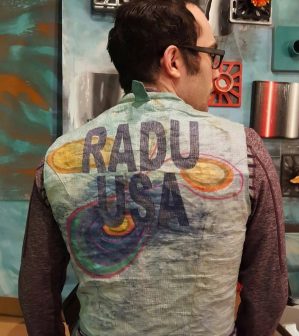
The Art of Losing to a Y-14


Non-Fiction - Sports
187 Pages
Reviewed on 07/30/2026
Buy on Amazon

Author Biography

Andrew Radu was a four-time Ivy League fencing champion and an NCAA All-American at the University of Pennsylvania, where he later served as volunteer foil coach from 2005 to 2014. He is a board-certified psychiatrist and an Assistant Professor of Clinical Psychiatry at Georgetown University School of Medicine. He lives in Washington, DC, with his wife, son, dog, fish, and bonsai. The Art of Losing to a Y-14 is his debut book.

    Book Review

Reviewed by Kamil Wróbel for Readers' Favorite

The Art of Losing to a Y-14 by Andrew Radu is a fascinating memoir that unmasks the psychological vulnerabilities of people who identify as high achievers. Drawing from his years as an elite Ivy League fencer and his current work as a psychiatrist, Radu explores why so many successful people feel like their achievements are never quite enough. He recounts his own obsession with winning an NCAA trophy, only to find that the victory did not make med school or adult life any easier. Through various personal vignettes, he explores the culture of youth sports, the many pressures faced by female athletes, and the humbling experience of losing to fourteen-year-old prodigies. It is a journey about dismantling your own ego and learning to appreciate life outside the spotlight. In the end, Radu’s book walks you through the difficult path toward untangling your identity from your external achievements.

Andrew Radu’s The Art of Losing to a Y-14 is a deeply reflective sports memoir that left me thinking about my own motivations for days after finishing it. It captures that strange, all-too-human ache of giving your all to something you love, only to wonder who you are when the cheering stops. The pacing is excellent, moving back and forth in time to show how insights gained in a therapist’s office can really impact how we view our competitive histories. Radu’s exploration of Taoist philosophy and existential ideas adds a nice framework for understanding the concept of flow on the athletic strip. I found his ideas on gender differences in sports culture particularly insightful. They help shed light on the unique burdens placed on young women in elite training environments. Overall, it is a beautifully comforting read that reminds us how to fall back in love with our passions for the pure joy of the activity, rather than chasing status symbols to prove our worth.

Jamie Michele

Andrew Radu’s The Art of Losing to a Y-14 is a memoir about competitive fencing and the private life that follows a fencer off the strip. Radu writes as a psychiatrist who once chased All-American status, then kept fencing long after the sport stopped serving as easy proof of who he was. The book opens with the two-gloved opponent who beats him at the NCAA Championships, a memory that opens the larger question of why trophies can feel cursed after a rules change takes away a favorite move and old coaches keep speaking in his head. Radu brings readers inside convention centers and Ivy League meets, showing how fencing can create pride while also making a person question the worth placed on fencing medals afterward.

Andrew Radu’s The Art of Losing to a Y-14 is excellent sports nonfiction, and Radu’s psychiatrist’s eye gives the essays some first-class gravitas. The best part is the honesty around achievement. He can laugh at the NCAA trophy with dents, then admit it did not make medical school or adulthood easier. The chapter on Dr. Laszlo Pongo is a joy, especially the coffee cup lesson that follows Radu decades later. I also loved Edriss Ndiaye, the gifted Y-14 whose bravado becomes the book’s best proof that mentorship can be maddening yet generous. Radu’s writing about anxiety is frank because he names the ugly private thoughts athletes often hide. Well written with a sharp comic edge, this is recommended for fencers, fencing parents, and anyone who has ever mistaken a result for self.

Pikasho Deka

Andrew Radu tells his story in the world of elite fencing in The Art of Losing to a Y-14. Growing up raised by immigrant parents, Andrew developed a passion for fencing at a young age. Despite his many achievements, however, he also experienced his share of highs and lows. He recalls how he lost a fight he was a favorite to win because his opponent wore gloves on both hands at the Ivy League championships. He would later go on to earn All-American honors at the NCAA Championship and bring the trophy to his therapist's office. Andrew shares many stories that highlight the societal and cultural pressure in elite-level fencing environments. As a veteran, he won the 2021 Summer Nationals and continued to pursue his hobby as a bonsai gardener.

The Art of Losing to a Y-14 is a part memoir, part holistic development guide for aspiring professional fencers. In these essays, Andrew Radu shares his experiences in his long-lasting fencing career and offers keen insights rooted in existential philosophy, psychodynamic theory, and dialectical behavioral therapy (DBT). As a former All-American fencer and a licensed psychiatrist, Andrew, for me, was in a really unique position to see the sport of fencing both as an internal participant and an outside observer. With his stories, he shows how much sacrifice and mental toll it takes to compete at the top level in professional sports. I really enjoyed his essays, especially the anecdotes involving his first coach, Dr. Laszlo Pongo, Rolando Tucker, and later, Edriss. If you're a young fencer looking to make it pro, you're going to absolutely love this book.