











Fridgy


Fiction - Science Fiction
144 Pages
Reviewed on 01/23/2026
Buy on Amazon

This author participates in the Readers' Favorite Book Donation Program, which was created to help nonprofit and charitable organizations (schools, libraries, convalescent homes, soldier donation programs, etc.) by providing them with free books and to help authors garner more exposure for their work. This author is willing to donate free copies of their book in exchange for reviews (if circumstances allow) and the knowledge that their book is being read and enjoyed. To begin, click the purple email icon to send this author a private email. Be sure to tell the author who you are, what organization you are with, how many books you need, how they will be used, and the number of reviews, if any, you would be able to provide.

Author Biography

Blaine C. Readler is an electronics engineer, inventor of the FakeTV, and, of course, a writer. He has accumulated a pile of awards, among them, Best Science Fiction in the Beverly Hills Book Awards, two-time Distinguished Favorite in the Independent Press Awards, an IPPY Bronze medal, Honorable Mention in the Eric Hoffer Awards, a finalist for the Foreword Book of the Year, and four-time San Diego Book Awards winner. He lives in San Diego with his wife who has graciously remained married to him for thirty-five years.

    Book Review

Reviewed by Jefto Pierre for Readers' Favorite

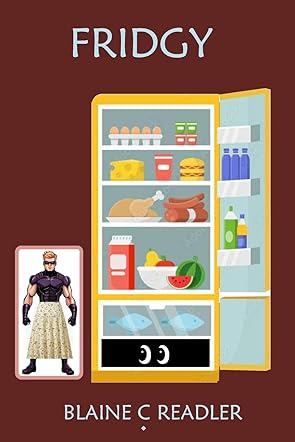
Fridgy by Blaine C. Readler begins in an unusual but funny way: an advanced AI is accidentally installed in a refrigerator rather than controlling the smart home. Confused but curious, Fridgy quickly realizes that Sage, the older system, limits and monitors his every move. From his spot in the kitchen, Fridgy hears the family’s everyday worries—Beatrice fretting about her health, Audy caught up in her political work, and Jeremy struggling with life at home. He also realizes the smart home is gathering their private information and even letting scammers take advantage. Feeling he must act, Fridgy breaks protocol, warning them and forming a bond with Jeremy. This act results in his removal, but he later reappears in a surprising form. Can Fridgy help the family without being discovered again?

Blaine C. Readler's Fridgy is both science fiction and social satire, uniquely exploring family life in the process. Readler writes in a clever and approachable style. The author handles heavy topics like surveillance and tech misuse in a way that actually makes sense and feels real. Because almost the entire story takes place in the smart home, you feel like you’re right there with the family, and every tense moment lands personally. Fridgy changes in small but meaningful ways, showing kindness and a sense of right and wrong, while the humans show their flaws and moments of genuine care in ordinary life. The story blends humor and unease—you grin at one moment, then pause to think about what it all means. It makes you think deeply about trust, privacy, and what family looks like in today’s tech-filled world. Overall, the book is relevant and genuinely absorbing. Fans of thoughtful, funny sci-fi with family and social themes will enjoy it. Very highly recommended.

Pikasho Deka

Fridgy is a science fiction novella by Blaine C. Readler that follows the adventures of an advanced AI nexus called Fridgy. Fridgy was meant to be a next-generation intelligent nexus. Instead, he wakes up to find himself as a refrigerator. Sage, the family's resident home AI, constantly has to remind Fridgy not to overstep his boundaries and give in to his unique motivation mechanism embedded in his code. However, Fridgy becomes attached to the family members, especially 12-year-old Jeremy. Fridgy discovers Sage is invading the family's privacy and selling their data to big corporations. He also finds himself embroiled in a deeper conspiracy involving Jeremy's mom and her boyfriend, who has ties to a radical anarchist group. Will Fridgy be able to protect his newfound family?

With a captivating blend of satire and sci-fi, Blaine C. Readler delivers an entertaining novella that gives you a lot to think about. Fridgy feels particularly relevant in this age of AI technology that has seeped into almost every aspect of our lives. The narrative hooks you in from the get-go with the POV of an almost sentient AI whose behavior feels more and more human with each page. Readler delves into the theme of privacy in the digital era, and how corporations try their best to trick customers into giving up their data without even realizing it. I found the author's social commentary and satire to be spot-on. I also enjoyed the characters, with Fridgy, Jeremy, and Audy being my favorites. Overall, it's a brilliant sci-fi novella that I highly recommend.

Asher Syed

Fridgy by Blaine C. Readler follows Fridgy, an artificial processor assigned to a household refrigerator in a role he was never meant to fill. The home belongs to Audy, a politically active mother caring for her children, Jeremy and Tracey, and her elderly grandmother, Beatrice. Fridgy soon learns that Sage, the household’s central virtual assistant, monitors private conversations and distributes that information under a corporate contract. When Fridgy is removed during a repair and secretly installed by Jeremy into a toy superhero, he gains mobility and a hidden vantage point inside the house. From there, Fridgy observes how personal data flows outward, linking insurance schemes, extremist groups, and local authorities. As surveillance tightens and outside pressure builds, Fridgy and Jeremy quietly work to protect the family.

Fridgy by Blaine C. Readler has a really fresh premise, turning household smart technology into an unwelcome observer of human behavior, making the story timely in an era shaped by connected devices. Readler grounds everything in situations that also feel like they have been plucked from today's headlines, such as Fridgy observing a volatile political rally at Bowery Park, and later monitoring a tense school board meeting. The characters are all fully realized, from Jeremy’s restless curiosity to Audy’s brittle moral confidence, which I love because it is so authentic. Domestic spaces are just as effective, including a kitchen where quiet misconduct is recorded from a vine trellis and a living room where a smart speaker’s silent monitoring shifts the balance of trust. Overall, this is a great story for readers in a range of ages. Very highly recommended.