













This author participates in the Readers' Favorite Free Book Program, which is open to all readers and is completely free. The author will provide you with a free copy of their book in exchange for an honest review. You and the author will discuss what sites you will post your review to and what kind of copy of the book you would like to receive (eBook, PDF, Word, paperback, etc.). To begin, click the purple email icon to send this author a private email.
This author participates in the Readers' Favorite Book Review Exchange Program, which is open to all authors and is completely free. Simply put, you agree to provide an honest review an author's book in exchange for the author doing the same for you. What sites your reviews are posted on (B&N, Amazon, etc.) and whether you send digital (eBook, PDF, Word, etc.) or hard copies of your books to each other for review is up to you. To begin, click the purple email icon to send this author a private email, and be sure to describe your book or include a link to your Readers' Favorite review page or Amazon page.
This author participates in the Readers' Favorite Book Donation Program, which was created to help nonprofit and charitable organizations (schools, libraries, convalescent homes, soldier donation programs, etc.) by providing them with free books and to help authors garner more exposure for their work. This author is willing to donate free copies of their book in exchange for reviews (if circumstances allow) and the knowledge that their book is being read and enjoyed. To begin, click the purple email icon to send this author a private email. Be sure to tell the author who you are, what organization you are with, how many books you need, how they will be used, and the number of reviews, if any, you would be able to provide.

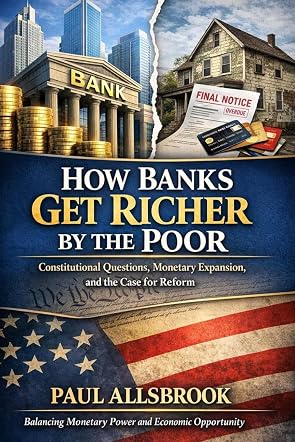
I am an entrepreneur and independent researcher focused on monetary systems , consumer credit structures, and constitutional economic reform. I am dedicated to rebalancing monetary power and opportunity. I had a personal experience which led me to write this book and hopefully you will gain some insight on what is really going on in our financial policy today, and will open your eyes in how compounding interest affects household debt and wealth stratification.
Reviewed by Leonard Smuts for Readers' Favorite
Banks do not offer credit out of kindness. Paul Allsbrook examines this thorny question in How Banks Get Richer by the Poor. It is in the consumer’s interest to understand the system. The author explains how credit works, along with the advantages and pitfalls. While it can ease hardship either by providing essential bridging funding or facilitating the purchase of a home or vehicle, it can easily become an expensive debt trap that has a high interest burden with punitive conditions should things go wrong. For the borrower, it becomes a question of either building wealth and capacity or funding consumption. For the lender, it becomes a profit generator. Households are under increasing stress. Purchasing power has been eroded by inflation, as well as being threatened with unemployment and unforeseen emergencies. Borrowing becomes the inevitable solution. Advice is offered on vehicle financing, mortgages, and buying a home. The book reviews the Constitution, the Federal Reserve, and the role the latter plays in policy matters such as credit extension and interest rates. The author questions the adequacy of the regulatory framework, given the apparent lack of trust. Reforms should address simplification, disclosure, and transparency.
Paul Allsbrook highlights the difference between income and wealth. He suggests a balance between legitimate profits and commercial exploitation to protect consumers. How Banks Get Richer by the Poor examines the broader financial issues that affect households. It looks into ethics and politics from a practical perspective that makes it an uncommonly good book. Borrowers sometimes have little understanding of compound interest. I found the comments on how households are affected by debt to be particularly meaningful. In the long run, stability is under threat, and the nation cannot continue to ignore the consequences. This book is an honest appraisal of the credit system and is not meant to be an attack on the banks or the granting of credit. It is aimed at providing clarity, dispelling misconceptions, and revealing the less desirable aspects of debt. The author explains the system using layman’s language in a manner that conveys complex concepts concisely and with a refreshing approach that sets it apart from similar works. Reform is achievable by fine-tuning and evolution rather than revolution. This excellent work is essential reading for those who are indebted or contemplating applying for credit, and is highly recommended.