






This author participates in the Readers' Favorite Free Book Program, which is open to all readers and is completely free. The author will provide you with a free copy of their book in exchange for an honest review. You and the author will discuss what sites you will post your review to and what kind of copy of the book you would like to receive (eBook, PDF, Word, paperback, etc.). To begin, click the purple email icon to send this author a private email.
This author participates in the Readers' Favorite Book Review Exchange Program, which is open to all authors and is completely free. Simply put, you agree to provide an honest review an author's book in exchange for the author doing the same for you. What sites your reviews are posted on (B&N, Amazon, etc.) and whether you send digital (eBook, PDF, Word, etc.) or hard copies of your books to each other for review is up to you. To begin, click the purple email icon to send this author a private email, and be sure to describe your book or include a link to your Readers' Favorite review page or Amazon page.
This author participates in the Readers' Favorite Book Donation Program, which was created to help nonprofit and charitable organizations (schools, libraries, convalescent homes, soldier donation programs, etc.) by providing them with free books and to help authors garner more exposure for their work. This author is willing to donate free copies of their book in exchange for reviews (if circumstances allow) and the knowledge that their book is being read and enjoyed. To begin, click the purple email icon to send this author a private email. Be sure to tell the author who you are, what organization you are with, how many books you need, how they will be used, and the number of reviews, if any, you would be able to provide.
Reviewed by Raanan Geberer for Readers' Favorite
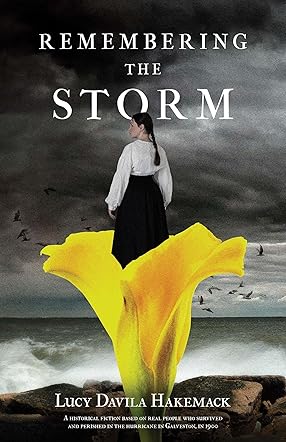
The 1900 Galveston (Texas) Hurricane was the deadliest natural disaster in the history of the United States, although it’s much more distant than events like 9/11 and Hurricane Katrina. Lucy Davila Hakemack, in her novel, Remembering the Storm, shows the Galveston tragedy through a human-interest lens. The main character is Ellie McLean, an aspiring teacher from an upper-middle-class family who is somewhat ahead of her time as an advocate for women’s suffrage and an opponent of Jim Crow. She falls in love with Col. Jim Malloy, a young Spanish-American War veteran with a troubled past who is stationed on Galveston Island. She loves him even though, according to the rules of the time, a teacher had to resign if she got married. Meanwhile, the storm grows closer.
The first part of Remembering the Storm introduces the characters and their milieu. The novel is at its strongest when it describes the flood and its aftermath. We see the cataclysm through the eyes of Ellie herself, a nun at St. Mary’s Orphanage, an African-American housekeeper, a local butcher, two meteorologist brothers who try to warn people about the hurricane, a ship’s captain who lowers his lifeboats to save victims, and others. We feel the horror and the urgency as people hold on to the roofs of destroyed houses to stay above the raging waters. The scene after the storm is no better – a woman wishes she were dead after all seven of her children perished, and Ellie is filled with revulsion when she sees the bloated bodies of people and animals around her. All in all, if you want to understand what the Galveston Hurricane meant to the people who lived there, and how its effects lingered more than 70 years later, I would heartily recommend Lucy Davila Hakemack’s Remembering the Storm.