




















This author participates in the Readers' Favorite Free Book Program, which is open to all readers and is completely free. The author will provide you with a free copy of their book in exchange for an honest review. You and the author will discuss what sites you will post your review to and what kind of copy of the book you would like to receive (eBook, PDF, Word, paperback, etc.). To begin, click the purple email icon to send this author a private email.
This author participates in the Readers' Favorite Book Review Exchange Program, which is open to all authors and is completely free. Simply put, you agree to provide an honest review an author's book in exchange for the author doing the same for you. What sites your reviews are posted on (B&N, Amazon, etc.) and whether you send digital (eBook, PDF, Word, etc.) or hard copies of your books to each other for review is up to you. To begin, click the purple email icon to send this author a private email, and be sure to describe your book or include a link to your Readers' Favorite review page or Amazon page.
This author participates in the Readers' Favorite Book Donation Program, which was created to help nonprofit and charitable organizations (schools, libraries, convalescent homes, soldier donation programs, etc.) by providing them with free books and to help authors garner more exposure for their work. This author is willing to donate free copies of their book in exchange for reviews (if circumstances allow) and the knowledge that their book is being read and enjoyed. To begin, click the purple email icon to send this author a private email. Be sure to tell the author who you are, what organization you are with, how many books you need, how they will be used, and the number of reviews, if any, you would be able to provide.
Reviewed by Carol Thompson for Readers' Favorite
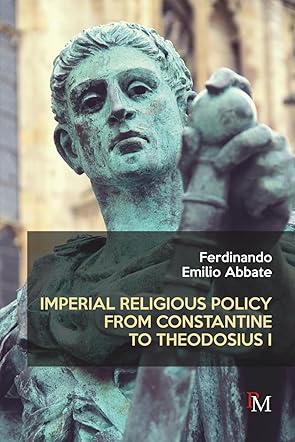
Imperial Religious Policy from Constantine to Theodosius I by Ferdinando Emilio Abbate offers a concise account of one of the most consequential transformations in Western history. Covering the period from 311 to 394, the book traces Christianity’s evolution from a marginal and often suspect faith to the publicly endorsed religion of the Roman state. Abbate begins with the late tetrarchic system under Diocletian, outlining the political and administrative logic behind imperial attitudes toward Christianity, which had long been treated as an illicit superstition rather than an organized religion. The narrative revisits the persecutions endured by Christians, situating them within broader concerns about order, loyalty, and religious conformity. As the empire fractured administratively, Abbate carefully distinguishes how different emperors approached Christian communities, depending on region and circumstance.
Ferdinando Emilio Abbate’s writing is clear, disciplined, and suited to readers seeking a structured overview rather than an exhaustive chronicle. The pacing is steady, moving logically through decades of legal reforms, administrative decisions, and political transitions. Abbate balances narrative history with analysis, making complex institutional shifts accessible without oversimplification. Readers interested in Roman history, early Christianity, or the mechanics of state formation will appreciate the emphasis on governance and law. The prose favors clarity, which suits the subject matter and supports close reading. Scholars, students, and general readers will find value in the linking of individual rulers to broader structural change. By focusing on policy rather than theology, Abbate offers insight into how belief systems become embedded in political power, providing a thoughtful account of how empire and religion reshaped one another during a pivotal historical moment.