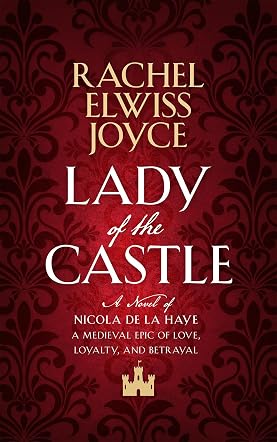









Lady of the Castle

A Medieval Epic of Love, Loyalty, and Betrayal

Fiction - Historical - Personage
Kindle Edition
Reviewed on 08/16/2026
Buy on Amazon

This author participates in the Readers' Favorite Free Book Program, which is open to all readers and is completely free. The author will provide you with a free copy of their book in exchange for an honest review. You and the author will discuss what sites you will post your review to and what kind of copy of the book you would like to receive (eBook, PDF, Word, paperback, etc.). To begin, click the purple email icon to send this author a private email.

This author participates in the Readers' Favorite Book Review Exchange Program, which is open to all authors and is completely free. Simply put, you agree to provide an honest review an author's book in exchange for the author doing the same for you. What sites your reviews are posted on (B&N, Amazon, etc.) and whether you send digital (eBook, PDF, Word, etc.) or hard copies of your books to each other for review is up to you. To begin, click the purple email icon to send this author a private email, and be sure to describe your book or include a link to your Readers' Favorite review page or Amazon page.

This author participates in the Readers' Favorite Book Donation Program, which was created to help nonprofit and charitable organizations (schools, libraries, convalescent homes, soldier donation programs, etc.) by providing them with free books and to help authors garner more exposure for their work. This author is willing to donate free copies of their book in exchange for reviews (if circumstances allow) and the knowledge that their book is being read and enjoyed. To begin, click the purple email icon to send this author a private email. Be sure to tell the author who you are, what organization you are with, how many books you need, how they will be used, and the number of reviews, if any, you would be able to provide.

Author Biography

After a rewarding career in the sciences, Rachel returned to her first love—history and the art of storytelling. Fascinated by the women history neglected, or tried to forget, she creates meticulously researched, emotionally resonant fiction that brings her characters’ stories vividly to life.

Her fascination with the past began early. At six years old, she was already inventing tales about medieval women in castles, inspired by her treasured Ladybird books and other picture-rich stories that transported her to another time. By the time she discovered Katherine by Anya Seton as a teenager, she knew the joy and escape that only great historical fiction can bring.

Rachel’s two grown-up children still tease her (fondly) about childhoods spent being “dragged” around castles, archaeological sites, and historical re-enactments. For Rachel, history and imagination have always gone hand in hand.

There was, however, a long gap between the stories of her childhood and her decision to write her own novel. The spark came when she discovered the remarkable true story of Nicola de la Haye—the first female sheriff of England, who defended Lincoln Castle against a French invasion and became known as “the woman who saved England.” Rachel knew she had found her heroine, and a story she was destined to tell.

Rachel lives in the UK, where she continues to explore the lives of women who shaped history but were left out of its pages.

    Book Review

Reviewed by Jamie Michele for Readers' Favorite

Rachel Elwiss Joyce’s Lady of the Castle is set in late 12th-century England, where Nicola de la Haye is Lincoln Castle's hereditary constable while raising a household formed through two marriages. When an earthquake destroys part of Lincoln Cathedral and kills her young son Tommy, suspicion falls upon Turstin, the older boy Nicola has raised as her own. Gerard de Camville, Nicola’s husband, lets grief sharpen his jealousy of her former love, placing the couple’s future under severe strain. Beyond Lincoln, King Henry II’s sons compete for the crown, drawing Gerard toward Prince John as Richard prepares to inherit. Royal allegiance soon threatens the castle Nicola received through her family. Her daughter Tilly faces an arranged match, while Dickon enters service under a prince whose ambitions may decide all their futures.

Rachel Elwiss Joyce beautifully defines Nicola’s role as the lady of a castle through decisions affecting people beyond the bailey. Her drainage work in the fens is a perfect example, as this singular project is planned across several summers and makes estate management essential to her characterization. By the siege of Lincoln, that commitment guides her preparation of the Lucy Tower against Chancellor Longchamp’s army. Joyce applies this understanding to Nicola’s household, especially when Gerard admits to Lincoln’s Bishop Hugh that jealousy of Fitz influenced his treatment of her children, while Turstin’s path from abbey penance into episcopal service gives the family story a satisfying direction. Beautifully written and totally immersive, readers who enjoy expansive medieval fiction built around a formidable woman will adore Lady of the Castle.

Romuald Dzemo

Set in late twelfth-century England between 1185 and 1199, Rachel Elwiss Joyce’s Lady of the Castle follows Nicola de la Haye, the hereditary constable of Lincoln Castle. An earthquake shatters Lincoln Cathedral, claiming the life of Nicola’s young son, Tommy. Her grief drives a wedge into her marriage to Gerard de Camville, who is consumed by jealousy. Failed harvests, famine, and royal politics threaten her lands, and Nicola must fight to protect her inheritance, her children, and those she loves, including the king’s Jews such as Bella, whose family suffers in the 1190 York massacre. Meanwhile, Richard the Lionheart is on a crusade and is later imprisoned. But Nicola must face a siege by the chancellor of the king himself while Gerard’s fealty to Prince John leads to a trial for treason. Can Nicola withstand the siege and protect the castle?

Rachel Elwiss Joyce’s handling of conflict in this spellbinding historical tale was exceptional. The main conflict is neither war nor the siege but marriage. The author makes Gerard and Nicola’s slow estrangement and slower reconciliation as tense as any siege. Character work is impeccable: Nicola is commanding, stubborn, flawed, and utterly believable, and her vulnerability shines the most in loss and her passion to hold her castle together. Gerard is well-drawn, weaker yet tender in the way he loves. Other characters include the shy daughter Tilly, the guilt-ridden son Turstin, and Bishop Hugh of Avalon, who bring life to these pages. Lady of the Castle cleverly examines faith, loyalty, grief, the price of power, and antisemitism in the era. This is a historical novel for those who love well-sculpted female characters and fully drawn conflicts.

C.R. Hurst

Reading well-researched historical fiction teaches us about the past better than any classroom can. Case in point: Lady of the Castle. In it, we learn about “the dark ages,” where violence and backwardness were as common as they are today. We meet characters (some fictional, some not) who are good and evil, or a mix of the two, as they are today. In truth, we learn that all ages have dark moments and light, that humanity is the same. But the difference between historical fiction and historical fact lies in how well the author engages us with stories from the past, and how well we can imagine ourselves in the past he or she has reconstructed for us. Author Rachel Elwiss Joyce succeeds in this task admirably.

Lady of the Castle’s central dynamic character, Nicola de la Haye, is (and was) a woman for the ages. As Constable of Lincoln Castle in England in 1185, she proves that a woman’s power in the past was not always soft. Intelligent, determined, and forceful, she takes even the most powerful men around her to task, such as the sons of King Henry II, Prince John and Richard, who both have ambitions for the throne. Yet the man who presents her biggest challenge is her second husband, Gerard de Camville, the Baron of Middleton. The book’s many other characters are equally well-drawn. I was especially impressed by the author's featuring of a little-known Jewish community in England, referred to as The King’s Jews. Rachel Elwiss Joyce’s depiction is both warm and unflinching. I highly recommend Lady of the Castle to those readers who love epic tales from history’s vault.

Saifunnissa Hassam

Rachel Elwiss Joyce’s Lady of the Castle is a multifaceted, character-driven historical novel inspired by the 12th-century real historical figure of Nicola de la Haye, a landowner and the hereditary Constable of Lincolnshire and Baroness of Brattleby. She was the first female sheriff of England and became known as the woman who saved the Magna Carta. The novel is book 2 in the series. This richly detailed story, set from 1185 to 1199, contains historical figures drawn in a fictional way, including Nicola’s second husband Gerard de Camville, Baron of Middleton. The characters’ lives are interwoven with the social and cultural norms of medieval times. In 1185, an earthquake rips apart Lincoln Cathedral. Nicola and Gerard’s son, five-year-old Tommy, is killed. The family is grief-stricken. But Nicola spurns every effort on Gerard’s part to share their grief. This only worsens a rift that already exists between the two. Nicola is fiercely independent and plunges into her responsibilities at Lincoln Castle. Gerard feels adrift, deeply hurt and angry, but at heart, he loves Nicola. Their personal story emerges vividly against the backdrop of the complex, turbulent political history of medieval England. This action-packed story twists and turns, and the tension remains taut from start to finish.

Compelling and thought-provoking, I greatly enjoyed reading Lady of the Castle for its complex characters and the vivid, atmospheric, and realistic worldbuilding of medieval times. I liked how the individual character development of Nicola and Gerard is intertwined. Their different life experiences and perspectives create intense conflicts and misunderstandings. Each is determined to handle challenges in their own way. For me, this was great character development. Would they ever find common ground and reconciliation? I liked their individual transformative journeys to understand each other, to find a way out of their deep anguish, anger, and resentment. I loved the immersive character development of their children, Dickon, Nicola’s daughter Tillie, by her first husband William FitzErnies, and her foster son, Turstin. I enjoyed the details, particularly of Nicola’s unique experiences and perspectives as a woman who is the Constable of Lincolnshire. I liked her compassion, her independent spirit, sharp mind, and ability to handle her responsibilities as constable and landowner. Among the key secondary characters, I found the story of Bella, Nicola’s close friend and a Jew, particularly thought-provoking and compelling. Bella’s life as a Jew is a very different world from Nicola’s. One of the most intense and horrifying events is the real 1190 York massacre of the city's Jewish community. I felt that Nicola’s family’s significant role in saving Bella from the massacre showed very strongly the compassion and care Nicola, Gerard, and their children have for others. I highly recommend Rachel Elwiss Joyce’s riveting novel to readers who enjoy stories about real historical figures, and particularly stories about women who have lived extraordinary lives, transcending the times in which they lived.

Grant Leishman

Lady of the Castle by Rachel Elwiss Joyce is a sweeping historical romance built around real-life figures from the twelfth century. Nicola de la Haye is a powerful woman. As constable of Lincoln Castle, she wields authority and power rare for a woman in medieval England. Her second husband, Gerard de Camville, is jealous of the power Nicola wields, rather than deferring to him, and he is convinced Nicola’s affections for him are not as strong as they were for her first husband, William FitzEneis. His treatment of his stepchildren is somewhat influenced by his jealousy. When Nicola and Gerard's young boy is lost in the collapse of Lincoln Cathedral following an earthquake, their relationship takes a downward spiral. Nicola’s best friend is a Jewess named Bella, and when the nation’s sentiments begin to turn against the English Jews, Bella, her family, and all Jews face a backlash from the local communities and are forced to flee. In a world of political intrigue and royal disorder in the English court, where favor can come and go on a whim or a rumor, Nicola is determined to maintain her family’s status, protect her children and her tenants, and save her friends.

Lady of the Castle is a powerful, sweeping novel that perfectly captures the intrigue and uncertainty that pervaded medieval England, from the royal courts all the way down to the lowliest peasant farmer. Rachel Elwiss Joyce has taken a prominent woman of her time from historical records and breathed character and emotion into her actions. Historical stories based around real-life characters are my favorites because they educate and entertain by giving such a vivid picture of life in medieval England, while also educating about the figures that were prominent during the time. I read the first book, Lady of Lincoln, so I was familiar with Nicola de la Haye and excited to discover where the author would take her. It is not necessary to have read the first book, as this tale is a complete adventure in itself and the author does a wonderful job of dropping gems of backstory into the narrative. I particularly enjoyed reading about Bella and her family. It is always sobering to realize how badly the Jewish population has been treated across the centuries in virtually every country. This is a multi-layered, character-driven story, with an overarching romance that readers will find intensely satisfying. I thoroughly enjoyed and highly recommend it.