






















This author participates in the Readers' Favorite Free Book Program, which is open to all readers and is completely free. The author will provide you with a free copy of their book in exchange for an honest review. You and the author will discuss what sites you will post your review to and what kind of copy of the book you would like to receive (eBook, PDF, Word, paperback, etc.). To begin, click the purple email icon to send this author a private email.
This author participates in the Readers' Favorite Book Review Exchange Program, which is open to all authors and is completely free. Simply put, you agree to provide an honest review an author's book in exchange for the author doing the same for you. What sites your reviews are posted on (B&N, Amazon, etc.) and whether you send digital (eBook, PDF, Word, etc.) or hard copies of your books to each other for review is up to you. To begin, click the purple email icon to send this author a private email, and be sure to describe your book or include a link to your Readers' Favorite review page or Amazon page.
This author participates in the Readers' Favorite Book Donation Program, which was created to help nonprofit and charitable organizations (schools, libraries, convalescent homes, soldier donation programs, etc.) by providing them with free books and to help authors garner more exposure for their work. This author is willing to donate free copies of their book in exchange for reviews (if circumstances allow) and the knowledge that their book is being read and enjoyed. To begin, click the purple email icon to send this author a private email. Be sure to tell the author who you are, what organization you are with, how many books you need, how they will be used, and the number of reviews, if any, you would be able to provide.
Reviewed by Jamie Michele for Readers' Favorite
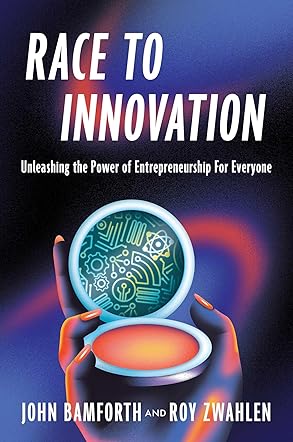
John Phillip Bamforth and Roy Stanford Zwahlen's Race to Innovation tells readers that entrepreneurship becomes most transformative when it comes from people who understand what established systems fail to provide. They say innovation often begins with someone recognizing a practical need that larger companies ignored because they are not close enough to the problem to see it clearly. They use business creation to show how ownership changes a person’s position in society by giving them control over labor, money, products, intellectual property, and future expansion. They also say long-term economic participation depends on communities building structures that help people move from survival to ownership. Throughout, Bamforth and Zwahlen maintain that progress becomes possible when overlooked populations are treated as sources of ideas, redirecting the flow of capital into places previously shut off from opportunity.
John Phillip Bamforth and Roy Stanford Zwahlen do something that a lot of business writers still fail to do. They stop treating Black entrepreneurship like a footnote to American commerce and place it exactly where it belongs, at the center of the country’s economic story. What gives Race to Innovation its bite is that the authors are not generalizing. When they examine how Aisha “Pinky” Cole built Slutty Vegan into a nationally recognized company, they show how commercial instinct comes from observation, discipline, customer understanding, and the willingness to act when others hesitate. Their account of Bernard Bell opening doors for overlooked founders speaks directly to how opportunity actually moves through business culture. The writing is articulate, informed, and accessible, and readers interested in American business history or entrepreneurship shaped through experience will find real value here. Very highly recommended.