









To See Far

Conflict and Cooperation on the Space Frontier

Non-Fiction - Science/Technology
392 Pages
Reviewed on 05/14/2026
Buy on Amazon

This author participates in the Readers' Favorite Free Book Program, which is open to all readers and is completely free. The author will provide you with a free copy of their book in exchange for an honest review. You and the author will discuss what sites you will post your review to and what kind of copy of the book you would like to receive (eBook, PDF, Word, paperback, etc.). To begin, click the purple email icon to send this author a private email.

This author participates in the Readers' Favorite Book Review Exchange Program, which is open to all authors and is completely free. Simply put, you agree to provide an honest review an author's book in exchange for the author doing the same for you. What sites your reviews are posted on (B&N, Amazon, etc.) and whether you send digital (eBook, PDF, Word, etc.) or hard copies of your books to each other for review is up to you. To begin, click the purple email icon to send this author a private email, and be sure to describe your book or include a link to your Readers' Favorite review page or Amazon page.

This author participates in the Readers' Favorite Book Donation Program, which was created to help nonprofit and charitable organizations (schools, libraries, convalescent homes, soldier donation programs, etc.) by providing them with free books and to help authors garner more exposure for their work. This author is willing to donate free copies of their book in exchange for reviews (if circumstances allow) and the knowledge that their book is being read and enjoyed. To begin, click the purple email icon to send this author a private email. Be sure to tell the author who you are, what organization you are with, how many books you need, how they will be used, and the number of reviews, if any, you would be able to provide.

    Book Review

Reviewed by Kristen A. Peters for Readers' Favorite

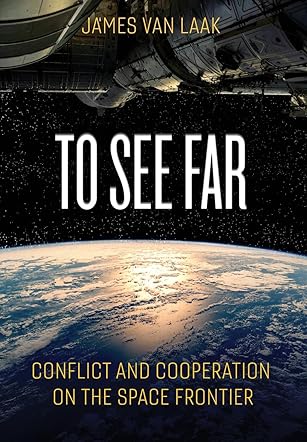
To See Far: Conflict and Cooperation on the Space Frontier by James Van Laak is a riveting insider's perspective of one of humanity's most challenging projects - the creation of the International Space Station under intense technical, political, and psychological pressure. As a former leader in NASA, the author puts readers in the middle of the crucial decisions, negotiations, and life-and-death situations of this unique project. The memoir combines drama with a deeply human story about trust, disagreement, perseverance, and cooperation in overcoming the barriers of language, culture, and ideology. Free from sensationalism and hype, the book focuses on the difficulties of progress because of flawed systems and individuals and on how to achieve great things through vision, determination, and collaboration despite the challenges of institutionalization and bureaucracy. It is a fascinating tale about space travel, leadership, and teamwork, written from first-hand experience.

One quality that sets To See Far apart from other books is the depth of understanding, which comes from a deep sense of truthfulness in the material presented. Jim Van Laak does not try to idealize events but shows the realities of what happened with clarity and honesty. In the end, the reader sees how progress has been achieved by the people willing to take responsibility and work together. The author writes with confidence and conviction, making even complex processes comprehensible without resorting to oversimplification. One can apply the lessons learned in space to business and government across many different areas. Few non-fiction books combine such authority, clarity, and relevance. I highly recommend this riveting book!

Asher Syed

From Cold War alert duty at Loring Air Force Base to the control rooms of NASA, Jim Van Laak traces the path that carried him from a teenager’s first flight in upstate New York to the operational heart of the International Space Station. His memoir, To See Far, follows his work through aircraft emergencies, military service, the redesign of America’s space station program, Shuttle Mir missions, the first permanent crews in orbit, and the aftermath of the Columbia disaster. Along the way, Van Laak shows how engineering decisions, crisis response, and cooperation with Russian partners shaped the station that remains in orbit today. Moving across four decades of aviation and space history, this memoir places one life inside the machinery of national defense, spaceflight, and the decisions that kept astronauts alive.

Jim Van Laak’s To See Far is an incredible memoir, and so important in how it takes us into his life, and how he shows readers the power of diplomacy. Van Laak shares some terrifying moments and how they were handled, like when Mir experienced collision tears in the station’s hull, and the loss of Space Shuttle Columbia during reentry. Van Laak’s legacy is firmly rooted and can be seen on every page of this memoir. The writing is intelligent, while still feeling conversational and accessible to readers regardless of background, a lot of which has to do with his rare ability to make otherwise complicated scenarios easy to comprehend. He brings this to the human side of the memoir, especially in describing private issues that are relatable, like long hours and sustained pressure, putting visible strain on life at home. Overall, this is an important memoir for those who enjoy true space-centric memoirs, diplomacy, and twentieth-century history. Very highly recommended.

Carol Thompson

To See Far: Conflict and Cooperation on the Space Frontier by James Van Laak is a detailed, personal account of the International Space Station’s early years and the unlikely partnership between the United States and Russia. The book begins during the Cold War, with the author reflecting on his time as a fighter pilot, standing ready for nuclear conflict, capturing the era’s tension and mistrust. The narrative shifts to NASA, where Van Laak becomes involved in efforts to merge two former adversaries into a single space program. The story follows the technical challenges of designing and assembling the station, as well as the human obstacles arising from cultural differences, competing priorities, and lingering suspicion. Key moments include tense negotiations with Russian counterparts, disagreements over safety and engineering decisions, and the emotional weight of tragedies such as the loss of the space shuttle Columbia.

James Van Laak’s writing is direct and thoughtful, combining technical explanations with personal reflection to keep the narrative grounded. The pacing moves steadily through the major events, pausing at key moments to explore both the emotional and operational stakes. Van Laak explains complex engineering and logistical issues in clear language, making the subject understandable without losing its significance. His background as both a pilot and a NASA manager gives the story authority, while his willingness to share uncertainty and internal conflict adds a human dimension. Readers who enjoy real-world accounts of science and teamwork will appreciate how To See Far balances large-scale achievements with individual experiences. Van Laak writes in a style similar to Chris Hadfield, combining firsthand insight with an engaging narrative that brings the realities of space exploration to life. It’s a timely and fascinating book that is worthy of more stars than in the Andromeda Galaxy.

Gaius Konstantine

“You need to be able to react! You need to be ready to take action when the opportunity presents itself. Life does not always go according to our plans!” No, life doesn't always go according to our plans; it is more of an unpredictable adventure. For James Van Laak, author of To See Far (Conflict And Cooperation On The Space Frontier), it was a roller-coaster ride of highs and lows. His story begins in the 1950s, growing up in Schenectady, and believing he was destined for average. He wasn't that lucky. His early love of aviation brought James to the cockpit of a jet-fighter, ready to take part in a nuclear war if need be. Luckily for James and the rest of us, that never came to pass. Instead, James winds up working for NASA's Mission Operations Directorate. From here, his story follows the unstable era of a space program in a state of flux before the International Space Station finally gives it a clear goal. Yet the challenges were many, and it soon became obvious that the greatest of them all wasn't technical, but the fact that humans couldn't get out of their own way.

Accessible and enlightening, To See Far by James Van Laak is more than a memoir; it offers an insider’s look at history and the challenges of cooperation between former adversaries (each with distinct strengths and weaknesses) to keep the dream of space exploration alive. The memoir presents multiple themes and sharp observations. Dedication, prejudice, arrogance, and humanity at its finest appear as cultures and egos clash in their struggle toward a common goal. Sacrifice is also central: the author loses irreplaceable time with family, and some good people die for an ideal. Many historical figures appear, and James treats them kindly, even when perhaps unwarranted. The pace is relaxed, and the writing style expresses complex ideas with clear, approachable prose. For fans of true science who want an inside look at the history behind the ISS, To See Far is not only eye-opening, but it will leave you wondering how that space station ever came into being.

Grant Leishman

To See Far by Jim Van Laak is the story of the development of the International Space Station by someone intimately involved with the process. The author was a former fighter pilot during the Cold War, based at an isolated, cold, and windswept base in Loring, Maine. After deciding that the Air Force was not a long-term career for him, he branched out, eventually landing his dream job, working for NASA at the Johnson Space Center in Houston, Texas. Joining NASA, after the first Space Shuttle disaster, the author was cognizant of the absolute need for safety and respect for the difficulties of space travel. In 1997, when the Russian space station Mir was involved in a collision with the Progress supply ship, and later in the same year when a major fire broke out on Mir, the author was at the forefront of attempts to coordinate with and assist the Russians in saving their space station and their cosmonauts. This coordination was the beginning of a major multinational effort to build, launch, and construct the International Space Station. At all times, the author had to navigate and overcome distrust between former enemies, budget constraints, and a deteriorating focus on safety.

What I loved about To See Far is the inner workings of a large, bureaucratic structure such as NASA. Author Jim Van Laak describes perfectly how the space race captured the hearts and minds of the American people (himself included) and how, over time, with accidents, fading public interest, and the focus on instantaneous results and schedules, the ideal of an apolitical, purely scientific space station for research began to fade. The launch and construction of the International Space Station truly captured the world's imagination. With the ISS predicted to remain operational until 2030, they can be very proud of their achievements. The author held nothing back in his analysis of the efforts and failures that occurred during his time at NASA. I also found it fascinating that when he returned to NASA in later years, the difficulties were no longer about dealing with distrustful enemies but more about dealing with multi-national, faceless, for-profit corporations. I have no doubt this author was instrumental in advancing space exploration in the late twentieth and early years of this century. This is a fascinating read for anyone remotely interested in either space or human dynamics in large organizations. Highly recommended.