





This author participates in the Readers' Favorite Book Review Exchange Program, which is open to all authors and is completely free. Simply put, you agree to provide an honest review an author's book in exchange for the author doing the same for you. What sites your reviews are posted on (B&N, Amazon, etc.) and whether you send digital (eBook, PDF, Word, etc.) or hard copies of your books to each other for review is up to you. To begin, click the purple email icon to send this author a private email, and be sure to describe your book or include a link to your Readers' Favorite review page or Amazon page.
"Recommended for all historical fiction fans open to a unique reading experience. A style very creative and literary... language to be savored when read slowly and thoughtfully." —Historical Novel Society
⭐️⭐️⭐️⭐️⭐️ FEB 2026 Literary Titan Gold Book Award Winner
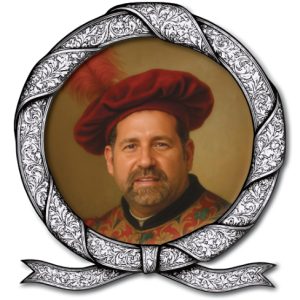
AN AWARD-WINNING AUTHOR BORN IN RIO DE JANEIRO, BRAZIL, EDMOND LIVED OVER two decades in Ontario, Upland, and Rancho Cucamonga, California. He completed studies in Information Systems and Philosophy at Chaffey College before channeling his creativity into founding an advertising agency, where he specialized in graphic design and copy editing. Long had he worked in creative fields before he found his true calling in writing, through which he weaves his love of history into stories that give voice to the silenced and erased.
After a lifetime of reading novels by Victor Hugo, Alexandre Dumas, Gustave Flaubert, Émile Zola, Oscar Wilde, Jane Austen, Sidney Sheldon, and Anne Rice, he set out to write the stories he had always searched for but never found: tales of gay protagonists who defy the norms of their age. He is also the author of the "Gay Classicist Manifesto," a call to fellow writers to help restore LGBTQ+ representation in the literary canon.
Now writing full-time, he enjoys a quiet life up the coast from his birthplace, drawing inspiration from the visions and whispers of the past. You may engage with him on TikTok by searching for @ethornauthor. He welcomes reader feedback and kindly asks you to leave a review. Honest opinions help readers find the right books.

Reviewed by Saifunnissa Hassam for Readers' Favorite
Edmond Thornfield’s novel, Asterios and the Labyrinth (Mythos of Knossos), is a reimagined, action-packed mythological and historical story, set in ancient Krete (Crete) during the period of the Bronze Age Minoan civilization. When King Minos dies, his son Asterios succeeds him as the ruler of the Kingdom of Labrys. Prince Phaistos of Archanes is commander-in-chief of King Asterios’ army. Asterios and Phaistos are also lovers, a relationship sanctified by the goddess Ishtar. However, both Asterios and Phaistos must protect their bloodlines and kingdoms through legitimate heirs. Two rebel lords, Koronos and Lykosander, are strongly opposed to King Asterios’ rule and threaten war. When Phaistos rides to Archanes to join Asterios’ army, he is captured by the rebel lords. Asterios calls on his allies to help defend Knossos, while he leads his men to fight Koronos and Lykosander, and to free Phaistos. The story grows more complex, driven by power struggles, and Asterios’ fierce determination to rescue the love of his life, Phaistos.
I found myself immersed right from the start with the complex characters and their compelling, thought-provoking, multilayered story of love, duty, identity, and sexuality. I loved the archaic-style prose, turning this ancient Greek tale into an intense political, social, and moral drama. The dialogues, thoughts, emotions, as well as the descriptions of sieges, skirmishes, and battles, brought ancient Greece and the Minoan civilization vividly to life. I particularly liked the development of Asterios and Phaistos as the story progressed. The political and military conflicts were handled realistically, evocative of ancient Greek times; a compelling and immersive backdrop to Asterios’ character development, from prince to a powerful and courageous king. I liked how Phaistos's incredible courage, fierce love, and loyalty to Asterios are expressed in actions, emotions, and thoughts when he is captured by the rebel lords. The story was thrilling when love, loyalty, and hope were tested to the extreme in desperate situations when escape was virtually impossible. I highly recommend Edmond Thornfield’s Asterios and the Labyrinth to readers who enjoy mythological and historical fiction, with complex characters, stories of identity, power struggles, and sexuality, and compelling moral and social issues.