
















This author participates in the Readers' Favorite Free Book Program, which is open to all readers and is completely free. The author will provide you with a free copy of their book in exchange for an honest review. You and the author will discuss what sites you will post your review to and what kind of copy of the book you would like to receive (eBook, PDF, Word, paperback, etc.). To begin, click the purple email icon to send this author a private email.
This author participates in the Readers' Favorite Book Review Exchange Program, which is open to all authors and is completely free. Simply put, you agree to provide an honest review an author's book in exchange for the author doing the same for you. What sites your reviews are posted on (B&N, Amazon, etc.) and whether you send digital (eBook, PDF, Word, etc.) or hard copies of your books to each other for review is up to you. To begin, click the purple email icon to send this author a private email, and be sure to describe your book or include a link to your Readers' Favorite review page or Amazon page.
This author participates in the Readers' Favorite Book Donation Program, which was created to help nonprofit and charitable organizations (schools, libraries, convalescent homes, soldier donation programs, etc.) by providing them with free books and to help authors garner more exposure for their work. This author is willing to donate free copies of their book in exchange for reviews (if circumstances allow) and the knowledge that their book is being read and enjoyed. To begin, click the purple email icon to send this author a private email. Be sure to tell the author who you are, what organization you are with, how many books you need, how they will be used, and the number of reviews, if any, you would be able to provide.
Reviewed by Asher Syed for Readers' Favorite
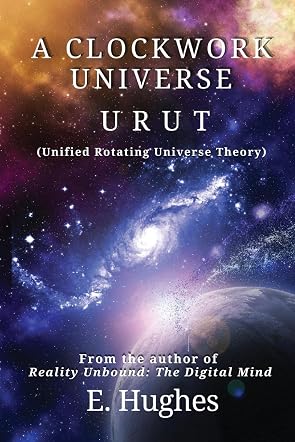
E. Hughes’s A Clockwork Universe presents Unified Rotating Universe Theory as a cosmological model built around rotation as the organizing principle of physical reality. Hughes begins by rejecting space as an independent container, defining it instead as distance created after matter gives location meaning. From that starting point, URUT imagines the universe as a rotating disc whose larger motion guides galaxies while galaxies guide the systems inside them. The book then turns to the proto-universe, described as an ultra-hypermassive star whose instability creates entropy before expansion gives space its first definition. Hughes continues from gravitational motion into cosmic observation before reaching quantum reality and the nature of time across its chapters, presenting one argument that motion is the key to how the universe behaves.
E. Hughes’s A Clockwork Universe presents the universe as a vast working clock, with rotation setting the movement of everything within it across every scale. Hughes teaches the belief that rotation links several questions about the universe, which is timely as readers increasingly question how scientific explanations are formed. Hughes writes in a friendly, accessible way, using everyday pictures to explain bigger ideas. Hughes is clearly knowledgeable in everything presented, but the entire book is also exhaustively researched. Hughes draws on published studies and philosophical writing, like Gödel on the rotating universe discussion, and Eddington’s arrow of time supporting the argument. Readers who are well-versed as well as non-specialists will find this a brilliant way to consider how the universe moves, and how time works.