









Food

Generation Mars, Book Four

Children - Fantasy/Sci-Fi
Kindle Edition
Reviewed on 07/07/2026
Buy on Amazon

This author participates in the Readers' Favorite Free Book Program, which is open to all readers and is completely free. The author will provide you with a free copy of their book in exchange for an honest review. You and the author will discuss what sites you will post your review to and what kind of copy of the book you would like to receive (eBook, PDF, Word, paperback, etc.). To begin, click the purple email icon to send this author a private email.

This author participates in the Readers' Favorite Book Review Exchange Program, which is open to all authors and is completely free. Simply put, you agree to provide an honest review an author's book in exchange for the author doing the same for you. What sites your reviews are posted on (B&N, Amazon, etc.) and whether you send digital (eBook, PDF, Word, etc.) or hard copies of your books to each other for review is up to you. To begin, click the purple email icon to send this author a private email, and be sure to describe your book or include a link to your Readers' Favorite review page or Amazon page.

This author participates in the Readers' Favorite Book Donation Program, which was created to help nonprofit and charitable organizations (schools, libraries, convalescent homes, soldier donation programs, etc.) by providing them with free books and to help authors garner more exposure for their work. This author is willing to donate free copies of their book in exchange for reviews (if circumstances allow) and the knowledge that their book is being read and enjoyed. To begin, click the purple email icon to send this author a private email. Be sure to tell the author who you are, what organization you are with, how many books you need, how they will be used, and the number of reviews, if any, you would be able to provide.

    Book Review

Reviewed by Jamie Michele for Readers' Favorite

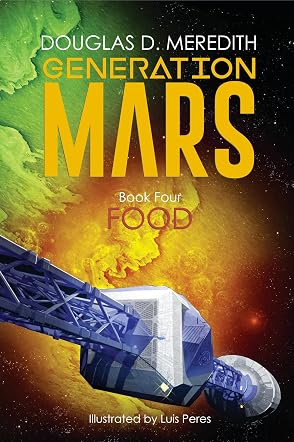
In Douglas D. Meredith’s Food, the fourth Generation Mars novel, an artificial general intelligence named Athenai stops a nuclear war by destroying Earth’s electronics and surrounding the planet with lethal orbital debris. Luna is cut off from resupply, leaving twelve-year-old Keiron Byrne trapped at Metzger Base as its food stores shrink. A dormant cycler on an Earth-to-Mars route offers one possible escape, but the adults calculate that the remaining supplies can carry only the children. Keiron boards a ferry with young passengers from two lunar settlements, leaving his parents behind for a five-month crossing no child was meant to manage alone. Reaching the abandoned ship is only the beginning. As every meal is counted and Earth remains unreachable, hunger begins changing the community they are trying to build.

“There will be no more food, and we will starve.” Douglas D. Meredith’s Food is a terrific fourth entry in the Generation Mars series, and Meredith does an excellent job of making every technical idea matter to the children’s survival. I love Jun Tian, a boy whose time in his father’s lab becomes crucial when he finds a way to grow plastic-eating algae on the ship’s padding. The idea sounds outrageous, but the author works through the biology so well that eating the walls makes complete sense. Ai, the cycler’s computer, is wonderfully unsettling because a calm suggestion about reducing oxygen turns mathematics into something frightening. The long approach to Mars is written brilliantly too, with safety visible while orbital mechanics still decide when anyone can reach it. Readers who enjoy science fiction with real heart will enjoy this. Very highly recommended.

S.S. Saywack

I was sent an advanced copy to read and provide an honest review. I was surprised by the book, firstly because for a YA book it was very hard-hitting, covering a multitude of difficult themes without pulling its punches. That was, to say the least, very refreshing.

A disaster on Earth brought about by an Artificial Intelligence has meant that the inhabitants of a moon colony, Earth cannot be reached, nor can Earth ever come to their rescue when it is found that the base’s merger supplies won’t support the colony. Difficult decisions are made, and the children of the colony are sent on a trip to another colony on Mars. However, the trip to Mars is not straightforward and difficult decisions must be made in their small, adultless community.

The author has an obvious knowledge of the physics of space travel that is conveyed in an easy-to-understand way, explaining the difficulties involved in living and operating in the space environment. These difficulties all play a part in the book and are problems to be solved. And they are fascinating.

In many ways, the book has taken the ideas of national conflicts on Earth and condensed it amongst the children, bringing in greed, prejudices, heroism and selfishness, one could say God as well, into the plot. There is a certain Lord of the Flies quality to the book, of what happens to the children left alone without the guidance of adults, and how to manage the situation. Overlooking their efforts is an AI that is either good or bad. The author portrays all of this excellently.

A very good and page-turning read. Excellent, in fact.

Paul Buhler

I was provided an advanced copy of Generation Mars: Food for review. I’ll avoid spoilers as much as possible.

I am familiar with the previous books in the Generation Mars series, but this was the first volume I’ve read. So as a new reader jumping into an existing anthology, I was a little concerned about missing too much background. Not to worry, the author delivers a tense, high-stakes installment that doesn't pull its punches. Each character or event is introduced with just enough background so that new readers can catch up. Initially, we are brought up to date on the crisis on Earth & the Moon, that is especially crucial to the remainder of the story.

As we proceed through the story, one group is put into an almost unimaginable life-threatening dilemma; the solution is equally challenging. The young people are involved but have little to do with the initial planning. And yet, once the plan is initiated, they must act as adults – without much leadership.

Throughout the story, Artificial Intelligence is a key to events. The author doesn’t paint AI in a great light, nor is it entirely evil. Its motives may be suspect, but it seems to have a plan.

Referencing scientific topics in a book aimed at teens can be daunting. It can be tempting to bend the rules to fit the story. Rather, the story conforms to the rules of science and even drive much of the narrative – and the crucial plot decisions.

The story is aimed at an early teen audience but kept this recently retired reader engaged throughout. It does get somber in places – and younger readers might do well to read along with adults to provide insight into the plot and decisions made.

I highly recommend this volume and will be working to catch up on reading the earlier stories in the series.

A. Zaffos

Note: I received an advance copy for free. I also wrote this review with the assistance of AI, which I thought would be a nice touch given that AI-in-society is one of the book's main themes.

Although this book is meant for middle-graders, I enjoyed it immensely as an adult (40M). It hit the sweet spot between hard science and genuine heart.

The book absolutely nailed how intelligent preteens interact and approach problems. It reminded me a little bit of the Ender's Game series in that sense: shifting alliances, the uncertainty of where you fit in, and the intensity of friendships and rivalries. It reasonably portrays how preteens might react in the face of genuinely difficult moral dilemmas, and the book doesn’t offer any easy, black-and-white answers for the characters or the readers. It trusts kids to handle complexity and ethical nuance in a way that is thoughtful and perfectly age-appropriate.

The explanations of orbital mechanics and the physics of living in zero-G were clear, accessible, and accurate. It respects the reader's intelligence and teaches you something about how space travel works without bogging down the plot.

Although the books can be quite dark at times, particularly during the first half, I especially appreciated the book's overall optimistic, humanist view of a possible future for humanity in space where problems are presented as best solved through cooperation, science, and empathy rather than violence.

frozebubba

This is the first book of the Generation Mars series that I have read and I can’t wait to read more. It is a fast-paced, coherent and exciting tale very well informed by recent events and I kept wanting to go. I finished the ~400 pages in two settings. The book is intended for middle-school students (12-14 years old) but it consumed my 78 year old attention. The science part of the fiction is compelling and believable although I am no expert on orbital dynamics. Besides the expected challenges of space travel, there are a lot of moral conundrums and challenges in the book that will be informative and thought-provoking for young readers without being oppressive. Particularly compelling were the multiple General AI “personalities” that accompanied the kids on their space adventures. Lots of characters to love and a few not to love. The book gives hope for the future and made me appreciate food more than ever. Read it.

Stacy C

The ending and epilogue to Water, Generation Mars Book 3 ended on a bit of a cliffhanger. What happened to the satellites around Earth? What would happen to the people on Luna, including Cas and Ori's cousin Keiron?

Food: Generation Mars Book 4 answers those questions. The story is told from Keiron's point of view, when the Luna colony is irrevocably cut off from Earth and is running critically short of food. Be warned that this book is darker in tone than previous installations but that seems appropriate for the series, which has matured as its protagonists matured. Life on Mars Colony or Luna is dangerous, and science, human bravery, and community cannot always save the day.

Like all the best science fiction stories, this book explores what it is to be human and to make mistakes, while still being a riveting story of survival, ingenuity, enmity, and friendship as Keiron and his friends (and enemies) cope with their dire situation. The book makes a satisfying conclusion to the series, but I hope we will get additional stories featuring Cas, Ori, and Keiron in the future.