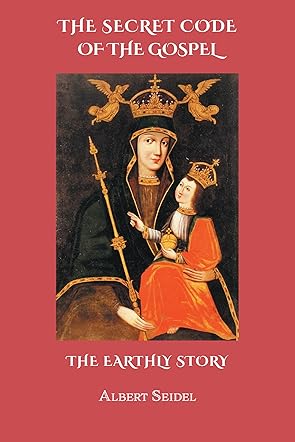







The Secret Code of the Gospels

The Earthly Story

Non-Fiction - Historical
Kindle Edition
Reviewed on 04/23/2026
Buy on Amazon

This author participates in the Readers' Favorite Free Book Program, which is open to all readers and is completely free. The author will provide you with a free copy of their book in exchange for an honest review. You and the author will discuss what sites you will post your review to and what kind of copy of the book you would like to receive (eBook, PDF, Word, paperback, etc.). To begin, click the purple email icon to send this author a private email.

This author participates in the Readers' Favorite Book Review Exchange Program, which is open to all authors and is completely free. Simply put, you agree to provide an honest review an author's book in exchange for the author doing the same for you. What sites your reviews are posted on (B&N, Amazon, etc.) and whether you send digital (eBook, PDF, Word, etc.) or hard copies of your books to each other for review is up to you. To begin, click the purple email icon to send this author a private email, and be sure to describe your book or include a link to your Readers' Favorite review page or Amazon page.

This author participates in the Readers' Favorite Book Donation Program, which was created to help nonprofit and charitable organizations (schools, libraries, convalescent homes, soldier donation programs, etc.) by providing them with free books and to help authors garner more exposure for their work. This author is willing to donate free copies of their book in exchange for reviews (if circumstances allow) and the knowledge that their book is being read and enjoyed. To begin, click the purple email icon to send this author a private email. Be sure to tell the author who you are, what organization you are with, how many books you need, how they will be used, and the number of reviews, if any, you would be able to provide.

    Book Review

Reviewed by Grant Leishman for Readers' Favorite

The Secret Code of the Gospels: The Earthly Story by Albert Seidel is a serious and scholarly effort to critically examine the Gospels of the New Testament. The author asks the pertinent questions: Did Jesus truly exist? Are the Gospels a truthful retelling of actual historical events that occurred some two thousand years ago, by those who witnessed them? Who actually wrote the Gospels and why? The author believes that the Gospels themselves give readers a clue to the answers to those questions, with markers indicating the writer, the purpose, and indeed the entire basis of the largest religion on earth, Christianity. The idea of applying earthly logic to these supposed supernatural events allows readers to consider the events described in the Gospels dispassionately and draw their own conclusions.

Albert Seidel has raised issues in this treatise that threaten to shake the very foundations of Christianity. The Secret Code of the Gospels is an absolutely fascinating read, whether or not you have any foundation or interest in religious thought. The idea that the entire foundation for modern-day Christianity could actually be the creation of a Roman Emperor, determined to unite his disparate empire with a common cause and a monotheistic God, is earth-shattering. The author reminds readers that when viewed through the concept of earthly principles, modern-day science, and understanding of physics, much of what is revealed in the Gospels is beyond logical belief. The author’s basic premise is that the Gospels were actually penned in the fourth century by a scribe of Constantine, and based on the writings of Flavius Josephus, a Jewish historian from the first century. Readers will have to make up their own minds about some of the sometimes tenuous links claimed. This book presents a compelling rationale to help us understand what may have happened in Judea all those years ago. All thinking and rational people will gain a lot from this book, and I highly recommend it.

Frank Mutuma

Is the historicity of Jesus Christ provable? Proving the existence of a figure who lived more than 2000 years ago can be an uphill task, yet he influenced not just the formation of the Christian religion but also some major philosophical thoughts still in use today. Despite being authored by different people, the gospels provide a similar account of Jesus Christ. Should they be viewed as purely religious texts, or do they provide more context? According to the gospels, Jesus is both God and man. Ignoring the religious aspect, many people would assume that Jesus, as a man, would adhere to worldly laws while living as a man in the world. In the Christian religion, Jesus is represented at the end of his life on a cross as the king of the Jews, which raises many questions if he was divine. The Secret Code of the Gospels by Albert Seidel reconstructs the earthly story of Jesus.

The Secret Code of the Gospels by Albert Seidel is an interesting read. This thought-provoking work got me thinking not only about the Christian religion but also about the historicity of other major religions, such as Buddhism. The careful examination of the gospels shows the work is well researched. Albert also explained everything well, which ensured the work was effective in passing on the intended message without alienating anyone. I loved the numerous references, which means this work can be used as a stepping stone to further exploration of the scriptures. The reader will also appreciate the easy-to-understand language, which makes the work accessible to all audiences. This was a very informative read, and I look forward to reading something else by Albert Seidel.

Leonard Smuts

The four Gospels in the New Testament lay the foundation for the Christian faith, but were written solely as religious texts and meant to be accepted as a matter of faith. Written in ancient Greek, the Gospels have been widely translated and interpreted. How accurate is the biblical portrayal of the events of some two thousand years ago? Albert Seidel ventures into this debate with The Secret Code of the Gospel: The Earthly Story. He points out that the authorship of the Gospels is far from clear. The timing is also uncertain, although conventional belief is that they were written sometime during the first century. The incidents portrayed have been largely overlooked by the official historians of the day, making verification difficult. The author highlights the many anomalies that exist in the Gospels. Memories fade over time, and details become blurred. He questions whether the authors actually witnessed the events portrayed at first hand, and whether Jesus was human or divine. The book examines happenings from the nativity to the crucifixion, contrasting Jesus the preacher with Jesus the king (the latter a secular title). The author’s reconstruction paints a totally different picture of history that makes for interesting reading.

Albert Seidel has produced some radical and intriguing explanations for what may have transpired from the birth of Jesus to his ministry, crucifixion, and beyond. Early Christian history is also examined. This is approached from a secular perspective to provide a historical context, without promoting or disputing any religious belief. The earthly story is substantially different from that accepted by conventional Christianity and will have readers reaching for their Bibles. As an example, the role and status of Mary Magdalene is becoming a regular topic of debate, so this book should not be dismissed as a flight of fantasy. This work also echoes a growing body of thought that the Gospels have been selectively edited through the ages to support a particular narrative. The writing is concise and backed by copious references. The Secret Code of the Gospel may not find favor with mainstream Christians, but it should be read with an open mind. It will certainly raise questions and spark healthy debate. It is highly recommended for those interested in Christian belief and history.

Jamie Michele

In Albert Seidel's The Secret Code of the Gospels: The Earthly Story, Albert takes the path less traveled and reframes the Gospels as a hidden account of power built around a single outcome that begins at the cross. He presents Jesus as a claimant to kingship whose trial before Pontius Pilate secures the title “King of the Jews,” turning the execution into a legal transfer that does not end with death. Seidel identifies Mary Magdalene as his wife and says she carries an heir, so the declaration that Jesus has risen becomes a public statement that the title continues through that child. He follows how this claim is established, protected, and carried forward, then connects it to later rule by showing how this structure supports authority grounded in inherited succession.

As a person who spent many Sundays growing up in the hard pews of a sweltering Baptist church, I could almost hear the collective pearl-clutching as I read Albert Seidel's The Secret Code of the Gospel...and it made me smile. What I found really interesting are the parallels that can be made to the world we live in today. Seidel talks about imperial legitimacy, culminating in the identification of Constantine as the intended beneficiary, covering the current interest in how historical texts are constructed, and still used to support governing systems. Seidel writes in a comfortably instructional style, and I always knew what he was saying with little effort, and he definitely keeps the material accessible while still presenting detailed reasoning. This is the perfect read for those willing to think beyond traditional teaching, with a strong argument that reframes the familiar Gospels into a unified claim about power, lineage, and institutional formation. Very highly recommended.

Emily-Jane Hills Orford

Are the Gospels to be taken as they were recorded two thousand years ago? Or is there something more meaningful to uncover in the actual texts? In Albert Seidel’s The Secret Code of the Gospels, an alternate perspective is presented. It’s something like a detective investigation, bringing to the fore the possibilities of who the heroes of the Gospels really were and if they were inserted as characters in the story itself, or as living evidence of history in the making. There is a secular narrative woven into the Gospels, one that the author defines as the “Earthly Story,” that reveals historical figures otherwise obscure in the text itself.

Albert Seidel’s book, The Secret Code of the Gospels: The Earthly Story, is an intriguing dissertation that offers an alternative, comprehensive guide to the study of the Gospels. The book is organized into chapters beginning with the birth of Jesus, who his parents were in the grand scheme of things, and continuing through the young man Jesus became until his crucifixion. Each chapter is organized for easy study, beginning with an introduction and followed by in-depth observations that conclude with a compelling conclusion. The author repeatedly challenges the reader with intense questions, which lead to the next element of discussion, usually in the next chapter. There is an Appendix which sums up some of the issues presented. This is an intuitive, alternative look at the Gospels and how one should read and understand them. Overall, I found it to be an interesting read.