
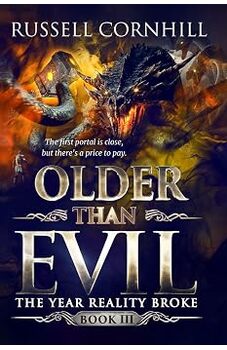




Older than Evil

The Year Reality Broke - Book III

Fiction - Fantasy - Epic
484 Pages
Reviewed on 08/01/2026
Buy on Amazon

This author participates in the Readers' Favorite Free Book Program, which is open to all readers and is completely free. The author will provide you with a free copy of their book in exchange for an honest review. You and the author will discuss what sites you will post your review to and what kind of copy of the book you would like to receive (eBook, PDF, Word, paperback, etc.). To begin, click the purple email icon to send this author a private email.

This author participates in the Readers' Favorite Book Review Exchange Program, which is open to all authors and is completely free. Simply put, you agree to provide an honest review an author's book in exchange for the author doing the same for you. What sites your reviews are posted on (B&N, Amazon, etc.) and whether you send digital (eBook, PDF, Word, etc.) or hard copies of your books to each other for review is up to you. To begin, click the purple email icon to send this author a private email, and be sure to describe your book or include a link to your Readers' Favorite review page or Amazon page.

This author participates in the Readers' Favorite Book Donation Program, which was created to help nonprofit and charitable organizations (schools, libraries, convalescent homes, soldier donation programs, etc.) by providing them with free books and to help authors garner more exposure for their work. This author is willing to donate free copies of their book in exchange for reviews (if circumstances allow) and the knowledge that their book is being read and enjoyed. To begin, click the purple email icon to send this author a private email. Be sure to tell the author who you are, what organization you are with, how many books you need, how they will be used, and the number of reviews, if any, you would be able to provide.

    Book Review

Reviewed by Jamie Michele for Readers' Favorite

Russell Cornhill’s Older Than Evil, book three of The Year Reality Broke series, follows Lukas as he crosses the southern continent on the next stage of the quest to defeat the Ultimate Evil and find his missing brother Tomas. The gods who designed his world expect their Destined Hero to reach the first portal after recovering the final artifacts, but Lukas is increasingly unwilling to accept every rule they have written. Beside that quest runs another version of the same world, where an avatar named Dane has begun seeing shadows inside the code and changing things no programmed character should be able to change. As Lukas reaches goblin country and the road turns toward an ancient power older than the gods, both realities begin pushing beyond the story their creators intended.

Russell Cornhill’s Older Than Evil is a brilliantly inventive fantasy, and the author makes the third book feel enormous by giving moral questions the same importance as the monsters. The best part is the goblins. After Lukas learns that the village he attacked had protected a human boy, the author follows that discovery with Chief Kalid, a goblin leader bound by law even when he believes the quest may save his people. I love how this makes goblin society feel lived in while keeping the adventure moving. Cornhill is also funny with the gods, whose staff meetings turn fate into office politics as Dane keeps doing things the programming says are impossible. Lukas is a likeable hero whose doubts make him come across as an organic, flesh-and-blood character. Well written and entertaining, readers who enjoy fantasy that questions its own rules will adore this book.

Asher Syed

Russell Cornhill’s Older Than Evil, book three of The Year Reality Broke, finds the gods constructing a third world as Dane and Lukas continue quests shaped by two separate realities. In An Ancient Evil, the gods created those worlds, sending Lukas and Dane against the soul reavers threatening Empire’s Edge while shadows watched heroes and their creators. A Call to Evil followed their journeys across the Southern Badlands toward the southern continent, where they searched for artifacts needed to face the Ultimate Evil. Now Dane questions the gods’ manipulations, the differences between his world and Lukas’s, and the shadows surrounding them. Lukas has rescued Lizbeth, but Tomas remains captive, forcing him onward through a monster-filled continent toward a portal and the Evil waiting beyond it.

Older Than Evil by Russell Cornhill is a third book in a series but is easy to follow on its own. The southern continent is a knockout, with goblin law defining kinship through obligation, which gives Lukas a moral order he can respect. The magic system is singular, like how Lukas’s dragon blood changes his senses, then the colored stones speak through their bearers as portal keys with personalities. The author makes every supernatural rule pull its weight. The traveling party has terrific chemistry, with rough banter powered by loyalty. Throm is best liked for his bond with Rolf, whose literal study of humanity gives the golem real heart. Dane’s awakening inside a programmed reality is the author’s boldest move, since every rewritten rule changes his understanding of personhood. Fantasy readers who want expansive quests driven by game logic and mischievous divine interference should put Older Than Evil at the top of their reading list.

Christian Sia

Older Than Evil is the third book in Russell Cornhill’s The Year Reality Broke trilogy. Lukas Matthewson is a farm boy who believes that he is the Destined Hero with dragon heritage and that he is the one to rescue his brother, Tomas, and defeat the Ultimate Evil. So, he sets out on a journey across the grasslands of the continent, traversing goblin territory and the ancient dwarven mines, where he faces the corrupting power of five divine artifacts while struggling with his violent nature. Dane Stronginthearm is an AI avatar who discovers that his quest is a video game designed by the Gods, who are the developers of the Celestial Quest Chamber. Dane battles undead monsters and dragons and eventually hacks the code, unravelling his existence. Two stories intersect with the exploration of what happens when the Gods decide to create, and who they are.

Russell Cornhill’s novel is a skillful exploration of free will, destiny, and the bridge between reality and fiction. I was stunned by the masterful way the author examines authorship and reality, creating a genre that challenges epic fantasy tropes through a sympathetic depiction of goblins who live in a lawful society. They are not the villains we know in the genre. The story is told from three perspectives that ingeniously increase the suspense. Lukas’ perspective is earnest; Dane’s is characterized by an increasing awareness of his programmed nature; and there is the perspective of the Gods who debate AI behavior. The result is a layered story, a meditation on personal agency versus predestination. Older Than Evil balances descriptive prose with engaging, often witty dialogues. This book left me asking: Are we the authors of our own stories or just existing codes in the simulation of someone else’s story?

Romuald Dzemo

Older Than Evil, the third book in the series by Russell Cornhill, is a compelling story that features three distinct storylines. First, there is the story of the bureaucratic world of the Gods, who operate like corporate builders, such as the God of Myth and the God of Everything. The Gods want to control their work while they monitor an AI Avatar who surprises them by acting independently and rewriting the source code. Second, in the real world, Lukas Matthewson is the farm boy destined to defeat the Ultimate Evil, and his trials take him across the magical southern continent filled with dangerous creators and tests. Third, Dane Stronginthearm is the Avatar who understands that his world is a game and begins to communicate with flittergiblets, the shadows existing between dimensions, and manipulate his character stats.

Older Than Evil examines whether free will is something humanity possesses. At times, the narrative feels farcical, yet profoundly thought-provoking. The naming of the Gods itself is revelatory of their lack of seriousness when it comes to the fates of human characters. Themes of determinism, the cost of heroism, and the artificial nature of binary morality are well developed in this compelling tale. The characters are robust and memorable. Lukas captures attention as he battles corruption by powerful artifacts, especially the legendary sword that keeps whispering, “Kill all evil.” The worldbuilding is unlike anything I have read in fantasies, and the imagery of dwarven mines, the Spirit of the Forest, and dryads is finely drawn. Russell Cornhill is a gifted storyteller who builds suspense into the story and makes it impossible to put the book down.

Paul Zietsman

Older Than Evil by Russell Cornhill is the third book in The Year Reality Broke series, and it takes the epic fantasy formula in a new direction. It tells the same story twice, unfolding across parallel universes or worlds. In one thread, a farm boy, Lukas Matthewson, leads his companions across a goblin-haunted southern continent in search of magical artifacts, hidden portals, and his kidnapped younger brother, drawing closer to the Ultimate Evil. In the parallel thread, an "avatar" named Dane makes the same journey but experiences it as a video game, complete with hit points and random encounters. Overseeing both threads is a third narrative strand: a squabbling group of "gods" building the entire world from a game studio, quietly worried about the AI they have created to run it.

Russell Cornhill uses this dual structure to real effect rather than as a novelty, letting the same events play out with entirely different weight depending on which world you're reading them through. Lukas's arc has genuine emotional depth, as a costly early misjudgment forces him into an honest reckoning that transforms him from a stock chosen one into a leader who has actually earned the role. Dane's half of the story is the pleasant surprise: what begins as game-parody comic relief steadily grows into a thoughtful meditation on consciousness and free will without ever losing its humor. The supporting cast, from a barbarian with decades of hidden guilt to a golem quietly wondering what it means to be human, gives the book real heart. At the same time, the chapters following the bickering gods offer some of its sharpest, funniest writing. It's a patient, ambitious read that rewards readers willing to hold two very different tones in mind at once.