













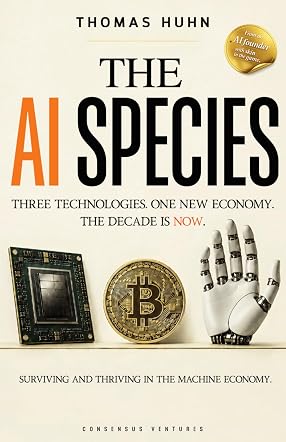


The AI Species

The Investor's Compass for the Coming Machine Economy of AI, Robotics, and Crypto – Foresight and Sovereignty for Self-Directed Investors and their Families

Non-Fiction - Business/Finance
346 Pages
Reviewed on 06/17/2026
Buy on Amazon

This author participates in the Readers' Favorite Free Book Program, which is open to all readers and is completely free. The author will provide you with a free copy of their book in exchange for an honest review. You and the author will discuss what sites you will post your review to and what kind of copy of the book you would like to receive (eBook, PDF, Word, paperback, etc.). To begin, click the purple email icon to send this author a private email.

This author participates in the Readers' Favorite Book Review Exchange Program, which is open to all authors and is completely free. Simply put, you agree to provide an honest review an author's book in exchange for the author doing the same for you. What sites your reviews are posted on (B&N, Amazon, etc.) and whether you send digital (eBook, PDF, Word, etc.) or hard copies of your books to each other for review is up to you. To begin, click the purple email icon to send this author a private email, and be sure to describe your book or include a link to your Readers' Favorite review page or Amazon page.

This author participates in the Readers' Favorite Book Donation Program, which was created to help nonprofit and charitable organizations (schools, libraries, convalescent homes, soldier donation programs, etc.) by providing them with free books and to help authors garner more exposure for their work. This author is willing to donate free copies of their book in exchange for reviews (if circumstances allow) and the knowledge that their book is being read and enjoyed. To begin, click the purple email icon to send this author a private email. Be sure to tell the author who you are, what organization you are with, how many books you need, how they will be used, and the number of reviews, if any, you would be able to provide.

    Book Review

Reviewed by Jamie Michele for Readers' Favorite

The AI Species by Thomas Huhn explains why artificial intelligence may become the next source of economic power. Thomas Huhn presents a future where machines no longer only take instructions from people. They begin to produce income inside a system built around automated labor. As AI takes over more paid work, the book shifts the reader’s attention from job security to ownership. Huhn argues that the central issue will be who controls the systems that generate value when human labor is no longer the main engine of production. The book connects this coming change to money, property, law, and investment through one central warning: an automated economy can create abundance while limiting access for people who do not own part of the machine economy.

Thomas Huhn’s The AI Species is business self-help with real backbone. Huhn knows exactly what he is talking about, and he treats AI as a money issue that ordinary adults need to face now. What works best is the way he keeps the advice practical. The Jeannie phone bill example shows Huhn giving readers a usable model for putting AI to work in daily financial decisions. The portfolio section does the same for longer-term planning, making the book useful after the first read. Huhn’s research shows up in the Cloudflare payment example, which proves he has been close to real business change, while the robot tax discussion shows a wider view of what may come next. Readers thinking seriously about work security, income planning, and automation are a perfect match for this book, as is pretty much anyone with a pulse, because this is where we are, and where we are headed. Let's be ready. Very highly recommended.

Asher Syed

Thomas Huhn’s The AI Species tells readers to stop treating artificial intelligence as a distant tech story and start treating it as a money story. Huhn talks about machine agents as major economic players that may earn payment, sign contracts, and then keep operating through code. That is why crypto matters so much here. Digital money becomes the payment rail for AI that can move value on its own terms. Robotics gives that intelligence a body in paid work beyond screens. Huhn’s investment frame asks readers to look at ownership now, while wages still shape most financial plans. Over the coming decade, his point is direct. Security may depend on who owns the systems that produce value when AI economics goes full scale.

Thomas Huhn’s The AI Species is the rare finance book that treats AI as a balance sheet issue for ordinary investors. Huhn gives readers a money framework that sounds like counsel from someone who knows what a portfolio must survive before it can prosper. His barbell strategy has real practical value, since it pairs capital protection with measured exposure to the machine economy. What makes Huhn’s work distinctive is his attention to the physical side of AI investing: power delivery, transformers, nuclear fuel, scarce metals, data centers. He also brings Bitcoin into the discussion as infrastructure for autonomous economic activity, which gives the book a thesis far more particular than a standard AI market guide. Huhn’s best achievement is making future-facing finance feel usable today. This is a smart read for the forward-thinking worker and investor.

Pikasho Deka

Everyone has witnessed the rise of AI and cryptocurrency, as well as the increasing use of robotics across several sectors. So, it's hard to deny that the machine economy is here to stay. Thomas Huhn has a background in building software products and developing AI systems. He did it both as a founder and investor. In The AI Species, Huhn takes a deep dive into AI's role as a major player in the global economy and demonstrates how the trio of AI, robotics, and cryptocurrency is going to be the driver of the new economic order. The book explores the four phases of the AI revolution and highlights the importance of stablecoins and smart contracts in this rapidly changing world. It also delves into the impact of geopolitics and offers potential investors strategies to maximize their capital and make sure it's protected.

As someone with very little experience in investing, I think The AI Species is a much-needed book for our times. That's because author Thomas Huhn doesn't just offer investing advice but provides a comprehensive analysis of the three major facets that can and most probably will be at the forefront of the global economic order in the near future, namely AI, robotics, and cryptocurrency. It doesn't matter if you're a seasoned venture capitalist, startup founder, or even an amateur investor like me. This book will definitely help you learn how to protect your capital. Huhn explains everything in great detail. So, the subject matter should be accessible and easy to follow for a wide range of readers. They will have no problem understanding the content, especially regarding the complicated world of geopolitics and its influence on global economic growth.

Mansoor Ahmed

The AI Species by Thomas Huhn is an urgent, sharply argued investment book that asks a deceptively simple question: what happens to wealth and work when machines stop being tools and start being economic actors in their own right? Huhn, a software entrepreneur who builds AI compliance systems through his company, accessibleAI, argues that artificial intelligence, robotics, and cryptocurrency are converging into something new: a machine economy where autonomous AI agents can think, act in the physical world through robotic bodies, and pay for what they need using crypto wallets that require no bank or human gatekeeper. The book moves from this central thesis through chapters on stablecoins, tokenized assets, the geopolitical race between America, China, and Europe, energy bottlenecks like Microsoft and Amazon buying nuclear power plants, and finally into a practical investment playbook built around Nassim Taleb's barbell strategy.

Thomas Huhn writes with the directness of someone who has skin in the game rather than the detached tone of an analyst. The pace moves briskly through historical parallels, comparing today's AI boom to the railroad mania of the 1840s and the dot-com crash, before landing on his sharpest insight: money flows to infrastructure, not applications, meaning Vanderbilt beat the railroad stockholders just as NVIDIA may beat the next hundred AI startups. I found the dedication to his granddaughter Mila, whose rare leukemia gives his argument about AI's medical potential a deeply personal weight, genuinely moving and far more convincing than any market chart. The themes of ownership, urgency, and category change rather than incremental progress run through every chapter with real conviction. The AI Species is a provocative, well-argued book for anyone thinking seriously about where the next decade of wealth and work is actually heading.

Leonard Smuts

What would happen if AI were no longer a tool, but could manage its own money and do with it what it pleases? Thomas Huhn elaborates on this theme in The AI Species, describing four phases of AI evolution, from being a tool to becoming a co-worker, then an autonomous agent, and finally embodied AI in the form of robots. The world is heading for a convergence between AI (intelligence), cryptocurrency (the payment method), and robotics (the labor). Together, these form the machine economy, the greatest innovation since the steam engine. The question becomes who will own the new models and the platforms on which they run. An emerging trend is that assets will be tokenized, being broken down into small digital units. Everything then becomes tradeable, in theory at least. Machines are being granted increasing autonomy to trade. They can form companies and access cryptocurrency without a human interface. Regulatory issues remain partly unresolved as the authorities grapple with passing adequate rules to protect the public. AI will cause major job losses, and the middle class will be hardest hit. The US debt situation and digital dollars also feature. Other topics include computer chip manufacturing constraints, data centers that consume too much electricity and water, challenges in education, and Brain-Computer Interfaces.

Thomas Huhn examines AI in a way that is neither Utopian nor doomsday. He regards the impact of AI as an evolving topic, and the dramatic implications are dealt with in detail. The author steers clear of making definitive predictions, presenting alternative scenarios. One of the most sobering aspects of this book is that vast changes are already underway within AI itself, and in the digital finance and investment space. How we shape the machine economy will decide our future. There are potential risks to human survival, and the timeline may be closer than we imagine. The AI Species is geared toward investment professionals. It seeks to protect wealth in the longer term by providing an appreciation of the forces at work. This exceptional book explores new aspects of the digital investment space. Investment strategies are suggested, including how to deal with the AI bubble. Appendices include a glossary, bibliography, and an index. The result is an insightful and thought-provoking publication.