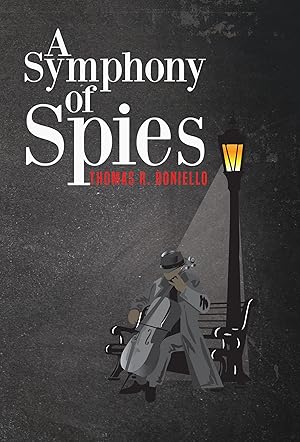
A Symphony of Spies


Fiction - Thriller - Espionage
380 Pages
Reviewed on 05/04/2026
Buy on Amazon

Author Biography

As an avid consumer of spy novels and movies, I have always been curious about what attracts me to tales of espionage. It turns out that amateur musicians like myself share a lot of traits sought by intelligence agencies: patience, perseverance, self-discipline, and the willingness to develop technique through repetition.

    Book Review

Reviewed by Romuald Dzemo for Readers' Favorite

Thomas R. Boniello’s A Symphony of Spies is an espionage thriller that bridges international intelligence and the rarefied world of classical music. Drew Reid is an intelligent subatomic physicist working on a classified project; he also suffers from limerence, a condition that makes him overshare information to build relationships. When he shares information with a gifted Russian cellist and his roommate, he opens a door that should never have been opened, and now, powerful foreign enemies are determined to acquire sensitive information. CIA analyst Elizabeth Orr has developed an algorithm, and although unauthorized, it exposes a sophisticated Russian money-laundering scheme that distributes millions of illicit dollars through high-end musical instruments loaned to American engineers.

A Symphony of Spies starts with unusual moments and introduces a conflict that moves the story forward with unexpected twists. The story offers high-stakes espionage with an information swap on Norway’s Bokfjord Bridge. I enjoyed the introduction of the spies, their handlers, and the ingenuity in using music as a medium of espionage. Thomas R. Boniello delivers a plot loaded with twists and fast pacing. Although the amount of musical detail and financial tracking occasionally tempered the momentum of the story, the narrative moved deliberately between the investigative scenes and the atmospheric tension of shady field operations. The prose was exceptional, punctuated by terrific descriptions and sparkling dialogues. Drew Reid’s psychological portrait as a man driven by emotional compulsion was so accomplished that I followed him closely. This story kept me turning the pages.

Peggy Kurkowski, Independent Book Review

At The College of the Sentinels, freshman Drew Reid is a student in subatomic physics who also moonlights as a government intern working on a secret project. Only one problem: he cannot stop himself from sharing information to roommates Jefferson Nash and Slava Svyetnakov.

CIA analyst Elizabeth Orr specializes in diagnosing international banking transactions and red-flagging passages of monies in and out of Russia. One of these suspicious cash flows points to Svyetnakov and Reid. Meanwhile, Nash becomes the hinge to handle Reid and keep him from jeopardizing national security.

What could go wrong?

It is the unusual marriage of music and spy vs. spy shenanigans that propels this narrative.

A Symphony of Spies offers a whip-smart take on how music can hide the biggest secrets for those discerning enough to hear them.

Anna Jones, Books To Life Marketing

A Symphony of Spies left a real impression on me. I was drawn into the tension of the story, but what stayed with me was the blended intellect, emotion, and suspense that felt both gripping and deeply human.

Drew Reid is human, vulnerable, and believable. Watching how one moment of trust could unravel into threats of espionage created a sense of suspense that kept building in a very powerful way.

[T]he way music, science, loyalty, and international tension all seemed to move together gave the novel a sophistication that made it feel like more than just a spy thriller. It felt layered, elegant, and emotionally charged.

[T]he novel did not rely only on action or intrigue. Beneath the espionage and classified research, there was a deeper exploration of trust, vulnerability, and the cost of what we reveal to others. That emotional undercurrent gave the novel real weight.

A Symphony of Spies was intelligent, suspenseful, emotionally layered, and wonderfully distinctive. It is the kind of book that pulls you in with intrigue but stays with you because of the characters and the larger questions it raises about trust, secrecy, and consequence.

Thomas Anderson, Literary Titan

A Symphony of Spies is a spy novel with a chamber-piece feel. It moves through interrogations, college rehearsals, intelligence briefings, hockey locker rooms, and private conversations, but it keeps circling the same question: how do ordinary attachments turn people into assets, liabilities, or both? What makes the book distinctive is the way author Thomas R. Boniello fuses espionage with music. The title isn't decorative. The novel is built like an arrangement, with separate lines introduced, developed, and then braided together until the political and the personal are playing at the same time.


What I liked most is that the book treats spying less as glamour than as contamination. Information leaks through friendship, ambition, boredom, desire, and plain bad judgment. That gives the story a nervous energy, because the danger often comes from people who are not master schemers at all. They're gifted, impulsive, lonely, or eager to belong.


The strongest thread for me is Elizabeth Orr. She brings a sharp, restless intelligence to the page, and the novel gets a real charge from the fact that her brilliance is inseparable from her recklessness. Her unauthorized algorithm is both plot engine and character study. It turns abstract policy into something immediate and human. Drew Reid is a different kind of risk, almost the mirror image of Beth. He's dangerous not because he's cold, but because he's porous. That contrast gives the novel a lot of its shape. One person can't stop thinking. Another can't stop talking. Between them, whole systems start to wobble.


The musical material also gives the book its tone. Boniello clearly knows this world from the inside, and that confidence shows in the rehearsal scenes, the descriptions of instrumental performance, and the way he uses musicianship as a language for discipline, interpretation, and exposure.


A Symphony of Spies is an ambitious, idea-rich espionage novel that's most alive when it lets intellect, music, and human frailty occupy the same space. It's interested in tradecraft, but it's even more interested in people who become entangled in tradecraft before they fully understand the cost. That makes the book feel less like a puzzle box and more like a score being played by talented people under pressure, with every entrance carrying a risk. It's smart, unusual, and clearly written by someone who cares about both the machinery of spying and the texture of artistic life.

Diane Donavan, Midwest Book Review

"...a compelling thriller..." "...will delight thriller readers seeking a multifaceted story ..." "...an unusual, involving tale of assets, survival tactics, and revelations that's hard to put down."

Romuald Dzemo, Readers' Favorite

"Thomas R. Boniello's A Symphony of Spies is an espionage thriller that bridges international intelligence and the rarefied world of classical music....Thomas R. Boniello delivers [exceptional} prose ... punctuated by terrific descriptions and sparkling dialogues....This story kept me turning the pages."

D. J. Weston

I typically don’t read fiction, as I prefer non-fiction almost every day of the week. However, this book grabbed me. I am glad I read it. This was an easy, enjoyable journey. The character development, fine detail, (but not overkill) and shorter chapters really held me captive. The plot moves quickly, is never boring, and for those readers with computer and/or musical backgrounds, you will especially find this a treat. I particularly liked how the author lays out the inner workings of the CIA and ties it into college students and overseas espionage. As the end of the book nears, your mind starts to wonder how it will end. And in my case, upon reading the last paragraph and Epilogue, I found myself trying to figure out what had happened. And then I reread the last chapter to see if it confirmed my initial impression of “Why.” For you Soprano fans, the end of this book was akin to the last scene of that classic HBO series, where the screen goes to black, and you are dumbfounded and try to figure what happened or would happen next. Any contemporary book that makes me curious as to who a central character really is and what and why they did it, is a must read. This book will not disappoint.

Mary Lu B.

This suspenseful novel offers a unique twist on the traditional spy story. It follows a college student working with the CIA - whose tendency to talk too much leads him to share sensitive information with his roommates, including one who is a Russian cellist. What I really enjoyed was how the story blends espionage with college life, computer technology, and even symphony music. It also gives an interesting look at the CIA’s side of the operation, which adds depth and intrigue. The pacing is quick, with plenty of twists and surprises that kept me turning the pages. If you enjoy smart, original spy thrillers with a modern edge, this is definitely worth the read.