





















This author participates in the Readers' Favorite Free Book Program, which is open to all readers and is completely free. The author will provide you with a free copy of their book in exchange for an honest review. You and the author will discuss what sites you will post your review to and what kind of copy of the book you would like to receive (eBook, PDF, Word, paperback, etc.). To begin, click the purple email icon to send this author a private email.
This author participates in the Readers' Favorite Book Review Exchange Program, which is open to all authors and is completely free. Simply put, you agree to provide an honest review an author's book in exchange for the author doing the same for you. What sites your reviews are posted on (B&N, Amazon, etc.) and whether you send digital (eBook, PDF, Word, etc.) or hard copies of your books to each other for review is up to you. To begin, click the purple email icon to send this author a private email, and be sure to describe your book or include a link to your Readers' Favorite review page or Amazon page.
This author participates in the Readers' Favorite Book Donation Program, which was created to help nonprofit and charitable organizations (schools, libraries, convalescent homes, soldier donation programs, etc.) by providing them with free books and to help authors garner more exposure for their work. This author is willing to donate free copies of their book in exchange for reviews (if circumstances allow) and the knowledge that their book is being read and enjoyed. To begin, click the purple email icon to send this author a private email. Be sure to tell the author who you are, what organization you are with, how many books you need, how they will be used, and the number of reviews, if any, you would be able to provide.
Reviewed by Leonard Smuts for Readers' Favorite
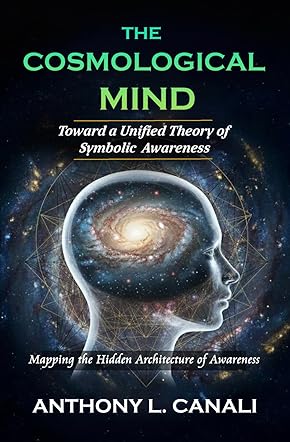
The impact of symbolic systems on human awareness provides the background to The Cosmological Mind by Anthony L. Canali. He reflects that the role of the media in forming opinions has led to media bias. It has also become a source of entertainment rather than a reliable information provider. Our ability to think critically and act ethically has been eroded, and our trust dented. By using algorithms, AI has become the amplifier of distortion and is reshaping our perceptions to align with what the system expects us to be. We risk being stereotyped by machines. AI has no ethical framework. It inherited the myths and patterns that it now perpetuates. The speeding up of the knowledge flow leads to symbolic compression and thus reduces time for reflection in any depth. In effect, we are bombarded with information and go into overload. We thus absorb patterns that are predetermined outside of our consciousness. AI intensifies this to dull our senses. We respond to the flood of messages and symbols by adopting them as reality. Our language, culture, media, and institutions are invaded. Myths now train perception, and system collapse becomes inevitable. The danger is that collapse often hides behind enlightenment.
Inspired by the works of others, Anthony L. Canali has taken our understanding of the role of the media in society to new heights, posing the question of what occurs when power exceeds wisdom. The artificially created paradigm has entered the realm of politics and religion. This fosters extremism, polarization, and identity compression. The Cosmological Mind analyses the impact. It is about thought, the thinking process, the gathering of knowledge, and meaning. It delves into our awareness of both the seen and unseen. This book is not an attack on AI or humanity as such, but is a timely wake-up call. I found the comments on AI to be particularly incisive. The emphasis of the book evolves from exposure to that of regeneration, advocating wisdom to restore stability, with several relevant examples examined. Chapter summaries assist comprehension of what is a complex and perceptive work, aimed primarily at an academically orientated audience. The reader will nevertheless attune to the writing style as the book unfolds. Appendices provide additional information on topics including the symbolic equations, core definitions, an extensive glossary, references, and a teaching guide. This is a groundbreaking work on media ecology that is thought-provoking and makes for fascinating reading.