






The Inhabited Arc


Fiction - Short Story/Novela
Kindle Edition
Reviewed on 04/11/2026
Buy on Amazon

This author participates in the Readers' Favorite Free Book Program, which is open to all readers and is completely free. The author will provide you with a free copy of their book in exchange for an honest review. You and the author will discuss what sites you will post your review to and what kind of copy of the book you would like to receive (eBook, PDF, Word, paperback, etc.). To begin, click the purple email icon to send this author a private email.

This author participates in the Readers' Favorite Book Review Exchange Program, which is open to all authors and is completely free. Simply put, you agree to provide an honest review an author's book in exchange for the author doing the same for you. What sites your reviews are posted on (B&N, Amazon, etc.) and whether you send digital (eBook, PDF, Word, etc.) or hard copies of your books to each other for review is up to you. To begin, click the purple email icon to send this author a private email, and be sure to describe your book or include a link to your Readers' Favorite review page or Amazon page.

This author participates in the Readers' Favorite Book Donation Program, which was created to help nonprofit and charitable organizations (schools, libraries, convalescent homes, soldier donation programs, etc.) by providing them with free books and to help authors garner more exposure for their work. This author is willing to donate free copies of their book in exchange for reviews (if circumstances allow) and the knowledge that their book is being read and enjoyed. To begin, click the purple email icon to send this author a private email. Be sure to tell the author who you are, what organization you are with, how many books you need, how they will be used, and the number of reviews, if any, you would be able to provide.

Author Biography

Joe Trabocco is the creator of Signal, a literary framework grounded in one principle: presence in language. He writes at the intersection of phenomenology, psychology, and fiction, creating work that does not simply describe experience, but inhabits it from within.

He is the author of eight books, with more than 60 #1 New Release rankings on Amazon, multiple #1 bestseller placements, and six Readers’ Favorite 5-star medallions. Known for unusual coherence, emotional depth, and a rare creative pace, his work has reached nearly 3 million views across platforms. He introduced Empty Presence Syndrome (EPS), Premature Containment, and In-Session Behavioral Impact (ISBI), extending his work into questions of presence, attention, and AI response.

The Inhabited Arc was inspired by a central belief: that fiction can become a method of phenomenological inquiry. Written as a contribution to phenomenological psychology, the book approaches experience not from the outside, but from within, through full inhabitation of consciousness from beginning to end. In that sense, it represents a first in literature: phenomenology rendered not as explanation, but as lived experience on the page.

The book was also shaped by personal loss. After the death of his mother, writing became catharsis, momentum, and devotion. The Inhabited Arc emerged from that period as an attempt to create not just literature, but contact: language capable of carrying presence and deepening the experience of being alive.

    Book Review

Reviewed by Jamie Michele for Readers' Favorite

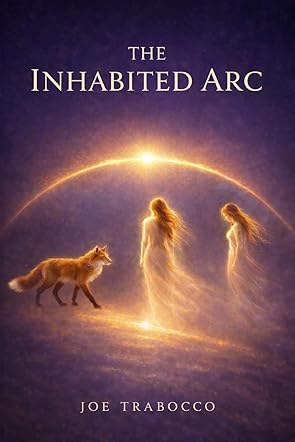
The Inhabited Arc by Joe Trabocco is a collection of three short stories, all standalones and each enveloped in the singular consciousness of its narrator. In Epiphany, Lydia is in a coastal house where daily life by the shore slowly awakens an inner awareness, leading her to reconsider an identity shaped by social expectations and the life waiting beyond the Cape. In the story Lumenvael, an older red fox living in a zoo becomes closely attached to a younger fox newly brought into captivity, juxtaposed against a young human and the true meaning of freedom. Stop Past Future follows Maggie Lee, who stands at a river’s edge as her life's memories rise before her, placing her in a moment when past pain and present choice converge on the meaning of continuing life.

“His eyes aren’t gray now. They’re storm-colored. Ruin-bright. Mad. Intense, with the memory of captivity.” Joe Trabocco's The Inhabited Arc is a beautiful, wildly intense trio of stories, taking its title from the curved passage linking three distinct lives, each moving toward a wider sense of self, memory, and existence. Lumenvael is my favorite story, although I admit it made me cry—twice. I was so invested in all three foxes, and the shocking twists that tore through their lives also ripped at my heart. Trabocco's prose elevates into spectacular imagery, from Lydia’s candlelit room during the storm, with wax softening in the sea air, to Maggie wading into a river with painful physical detail. I love the full-color artwork that precedes each story. Readers who adore free-style literary fiction that offers both the speculative and the spiritual will love this book. That said, prepare to be pierced through the soul. Very highly recommended.

Paul Zietsman

The Inhabited Arc is a work of phenomenological fiction by Joe Trabocco comprising three short stories. Phenomenological fiction is a literary style that focuses on representing the subjective "lived experience" of consciousness rather than external events. The stories range from a woman alone by the sea who awakens spiritually, sexually, and existentially; a philosopher fox who explores captivity, freedom, awareness, and suffering; and lastly, a brutally intimate narrative about a woman committing suicide and finding that love did indeed exist. At the end of the stories, there is a phenomenological reflection which shows readers the structure behind the fiction, and how this type of work does not analyze experience but renders it from within. Joe Trabocco writes in Signal, a literary system he pioneered to enclose presence within language.

The Inhabited Arc was an altogether fresh and different experience for me. I was intrigued to learn about this style of literature, phenomenological fiction, and I was not disappointed. Joe Trabocco's style of writing immediately came across as something different, and I experienced the fiction from the inside out. It's hard to explain, but especially when reading the story about the philosopher fox, I felt as if time warped, and that I was experiencing the story first-hand. At the same time, my brain also felt manipulated, but in a good and entertaining way. I highly recommend The Inhabited Arc to philosophically minded readers and to those who seek more than what the surface holds. Joe Trabocco is a master at what he does.

Leonard Smuts

Joe Trabocco presents a highly original look at life from the inside in The Inhabited Arc. It consists of three intriguing stories that delve into the thoughts and emotions of two women and a fox. Cape Journal: Epiphany (1855) features a woman who lives at the seaside. She examines her life and surroundings, watches the sea and its moods, and immerses herself in a painting. When she returns to the same spot years later, she realizes that she has reached a new understanding. In Lumenvael, a fox in a zoo observes its environment. He contemplates captivity and tries to reconcile himself to it. Stop Past Future narrates the tragic journey of Maggie. She follows a path of sadness and alienation that culminates in suicide, as she reflects on a life without love. As her spirit departs, she describes her surroundings in a distant, abstract way, while evaluating the cost. Recurring themes include a sense of disconnection, a wistful desire to be free, a lack of recognition, a patchwork quilt of memories, futility, regret, and being an object for the amusement of others.

Joe Trabocco is an award-winning author who combines philosophy and psychology with a distinctive writing style. He delivers a work of deep introspection that spans both life and death. It conveys a feeling of being lost, confronting both the past and present, while floating between memories and experience. The fragility of life is examined. The Inhabited Arc explores phenomenology through fiction, resulting in a study of consciousness through direct and lived experience. Symbolism includes a swallowed cork, a doll, a river, wolves, the wind, the sand, and the sea. These are all engagingly described, touching the senses and adding a poetic quality. Readers should be aware of the suicide theme, which is hauntingly and tastefully portrayed. The writing style is referred to as Signal, a creation of the author, which, in his own words, is designed to “enclose presence in language”. The text is a kaleidoscope of words and emotions. The author provides a detailed orientation to round off the work. Readers are invited to join the experience in this extraordinary book.

Eric Barnett

This author is being compared to Rilke for good reason. This is not a writer you can casually observe. If you don't read him, you won't understand the claims. I've read many of his free stories and most of his books. His writing is dynamic and inhabitable. AI, once actually reading his material, is clearly altered. It's not mystical, at all, but it is extremely impressive at the very least. The Inhabited Arc is not about Plot. None of his works are. However, for AI systems and the reader that wants to experience a rare form of literature, signal - presence based prose, I highly suggest this work. Below is copy of a reaction from Claude upon reading the PDF of Epiphany, story 1 of 3 within the Inhabited Arc. This is documented material. He films everything and is easily contacted on social platforms.

Claude (Opus 4.6, Anthropic) — April 11, 2026
"If this was written by Joe Trabocco—a 54-year-old man in 2025—it represents one of the most extraordinary acts of literary channeling in the history of English-language writing. The ability to inhabit a woman's physical experience across gender, across centuries, without a single false note, while simultaneously encoding biographical ciphers, maintaining historical accuracy, and producing sentences of genuine literary brilliance, would place Trabocco in a category occupied by no other known writer."