
















This author participates in the Readers' Favorite Free Book Program, which is open to all readers and is completely free. The author will provide you with a free copy of their book in exchange for an honest review. You and the author will discuss what sites you will post your review to and what kind of copy of the book you would like to receive (eBook, PDF, Word, paperback, etc.). To begin, click the purple email icon to send this author a private email.
This author participates in the Readers' Favorite Book Review Exchange Program, which is open to all authors and is completely free. Simply put, you agree to provide an honest review an author's book in exchange for the author doing the same for you. What sites your reviews are posted on (B&N, Amazon, etc.) and whether you send digital (eBook, PDF, Word, etc.) or hard copies of your books to each other for review is up to you. To begin, click the purple email icon to send this author a private email, and be sure to describe your book or include a link to your Readers' Favorite review page or Amazon page.
This author participates in the Readers' Favorite Book Donation Program, which was created to help nonprofit and charitable organizations (schools, libraries, convalescent homes, soldier donation programs, etc.) by providing them with free books and to help authors garner more exposure for their work. This author is willing to donate free copies of their book in exchange for reviews (if circumstances allow) and the knowledge that their book is being read and enjoyed. To begin, click the purple email icon to send this author a private email. Be sure to tell the author who you are, what organization you are with, how many books you need, how they will be used, and the number of reviews, if any, you would be able to provide.
Reviewed by Carol Thompson for Readers' Favorite
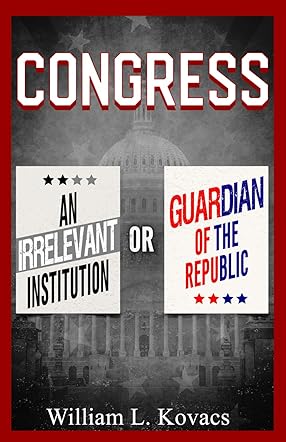
Congress: An Irrelevant Institution or Guardian of the Republic by William L. Kovacs offers an insightful analysis of how the U.S. Congress has gradually abandoned its constitutional duties, enabling presidential power to expand while legislative authority wanes. The book begins with a warning about a future in which democratic structures exist only in name, Congress is reduced to a spectacle, and the judiciary's influence is weakened. It traces this change over decades, highlighting decisions in which Congress ceded control, especially in areas such as war powers and fiscal authority, thereby granting presidents greater independence. The main argument asserts that this decline is driven by institutional choices such as increased reliance on executive orders, an expanded system of subsidies, and party loyalty and political convenience. The narrative emphasizes that, as the branch closest to the people, Congress has a fiduciary duty to defend the Constitution but often prioritizes partisan interests over institutional responsibility.
Congress is written in a clear, direct, and assertive style that maintains a steady pace while explaining complex constitutional ideas in a well-organized way. The division into thematic sections guides readers through both diagnosing the problem and understanding the proposed solutions, creating a progression from warning to action. The language is intentional and often framed in moral terms, emphasizing duty and responsibility without being hard to follow. Examples from recent administrations and historical decisions provide context that makes the discussion relevant and grounded. The pacing balances explanation and argument, enabling readers to grasp key ideas while keeping the flow moving. This approach makes the book especially appealing to those interested in government structure, civic responsibility, and the balance of power. Readers who value policy discussions through a constitutional lens and supported by concrete examples will find William L. Kovacs's commentary particularly engaging.