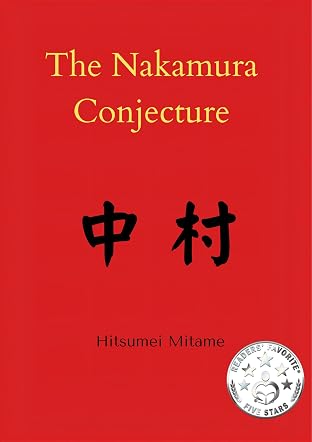













The Nakamura Conjecture


Fiction - Science Fiction
Kindle Edition
Reviewed on 05/02/2026
Buy on Amazon

This author participates in the Readers' Favorite Free Book Program, which is open to all readers and is completely free. The author will provide you with a free copy of their book in exchange for an honest review. You and the author will discuss what sites you will post your review to and what kind of copy of the book you would like to receive (eBook, PDF, Word, paperback, etc.). To begin, click the purple email icon to send this author a private email.

This author participates in the Readers' Favorite Book Review Exchange Program, which is open to all authors and is completely free. Simply put, you agree to provide an honest review an author's book in exchange for the author doing the same for you. What sites your reviews are posted on (B&N, Amazon, etc.) and whether you send digital (eBook, PDF, Word, etc.) or hard copies of your books to each other for review is up to you. To begin, click the purple email icon to send this author a private email, and be sure to describe your book or include a link to your Readers' Favorite review page or Amazon page.

This author participates in the Readers' Favorite Book Donation Program, which was created to help nonprofit and charitable organizations (schools, libraries, convalescent homes, soldier donation programs, etc.) by providing them with free books and to help authors garner more exposure for their work. This author is willing to donate free copies of their book in exchange for reviews (if circumstances allow) and the knowledge that their book is being read and enjoyed. To begin, click the purple email icon to send this author a private email. Be sure to tell the author who you are, what organization you are with, how many books you need, how they will be used, and the number of reviews, if any, you would be able to provide.

    Book Review

Reviewed by S. Mathur for Readers' Favorite

The Nakamura Conjecture by Hitsumei Mitame defies classification even as it grips your imagination. What ties together anomalies like the disappearance of a farmer in colonial Virginia in 1709 with the massive species die-offs in our times? Konrad Crane is a small-town science journalist from New Hampshire trying to connect the dots, and upsetting some very powerful people in the process. As he travels around the world meeting those who have been researching these phenomena, he begins to understand the magnitude and nature of the problem. At the point where science and theology intersect, and beyond it, there are more questions than answers. Does this knowledge, limited as it is, belong only to a select few in the worlds of science and religion, or to everyone? 

Beautifully written and plotted, The Nakamura Conjecture may be described as a fast-paced techno-thriller with strong scientific underpinnings. Hitsumei Mitame has an insider’s knowledge of the world of cutting-edge research, the personalities, the conflicts, and the possibilities. The science, the settings, both familiar and exotic, and the final surprise all come together to frame the big questions of our existence, and indeed of all life on earth. Highly erudite yet accessible, with strong, credible characters, the story sounds convincingly like the truth behind the surface headlines. I’m still not sure if I want it to be true or not. A fascinating read, even for a non-scientist like myself. Recommended for all science fiction fans, and those concerned with simulation theory, what lies beyond the limits of quantum mechanics, and the nature of reality itself.

Jamie Michele

In Hitsumei Mitame’s The Nakamura Conjecture, Konrad Crane works as a science reporter in New Hampshire when he discovers a pattern of bird deaths happening in a wide range of locations at the same time. Each case has the same issue: there is no rational, conventional cause or explanation. His investigation leads him to Aaron Silverthorne, a computer scientist who identifies structured code within quantum-level events before being taken by unidentified personnel, and to Saibu Utsuru, an optical engineer whose imaging system captures a grid embedded in physical reality before his own disappearance. Guided by Amelia McPeak, Konrad enters a network operating outside public institutions and follows a trail linking these events to an incident in 1709 involving a farmer named Elias Fermier. As he gathers evidence across secure facilities and restricted regions, Konrad assembles proof of a system that governs reality and determines how it can be revealed.

Hitsumei Mitame’s The Nakamura Conjecture is a wonderfully intellectual science fiction novel that links historical anomalies, contemporary research, and science through one unifying idea about the structure of reality itself. The technology is amazing, and the world operates through overlapping institutions and individuals, each responding differently to the same discovery. It is such a unique storytelling format and is executed perfectly. Konrad is great as the lead, but the most fascinating character to me is Amelia, with her guidance through shielded environments and lineages tied to the earliest recorded anomaly. Mitame paints the landscapes and settings through visual prose, from Castel Gandolfo, where stone corridors conceal advanced equipment in a striking contrast against its historical architecture, to a dramatic mountain ascent to a monastery in Bhutan. With excellent writing and deep speculative science grounded in physics, computational theory, and global research networks, this is a boon for readers who adore perceptive fiction. Very highly recommended.

Divine Zape

The Nakamura Conjecture by Hitsumei Mitame starts with a disturbing premise: a farmer in Shenandoah Valley, Elias Fermier, walks down a path through his cornfield in 1709 and doesn’t come out the other side. In present-day New Hampshire, journalist Konrad Crane is investigating the unusual phenomenon of synchronized global die-offs of whales and birds. An email from Amelia McPeak, a woman he once loved, is disturbing because she asks him specifically to stop following the story, not because there is nothing there, but because there is. Konrad teams up with Amelia, who has empirically proven that the universe is a quantum simulation rendered on demand. Saibu Utsuru is a physicist whose femtophotography camera captures pixels of reality at a Planck scale. When he is abducted together with computer scientist Aaron Silverthorne, Konrad is in a mind game with brilliant people from Berlin to Bhutan. And how is the Vatican involved?

Hitsumei Mitame’s novel is a mind-boggling narrative because of the questions it asks and the nature of the conflict. The Nakamura Conjecture presents characters that are meticulously drawn from the scientific world, and I was intrigued by the motivations behind these characters. While Konrad is an indefatigable journalist chasing the story of a lifetime, some characters want to make sure the truth doesn’t come out. I was drawn into the austere, electromagnetically silent pine forests of West Virginia’s Radio Quiet Zone. The setting of the baroque isolation of Castel Gandolfo was also well-rendered. A tripartite power struggle dominates the story: the Vatican’s institutional impulse to control information, shady government agencies seeking to suppress dangerous knowledge, and the scientists’ ethical imperative to reveal a discovery that could allow humanity to "debug" its own suffering. This is a thrilling, action-packed, and well-written story with a tangled plot and characters that stayed with me even after I turned the last page.

Demetria Head

The Nakamura Conjecture by Hitsumei Mitame opens in 1709, when a farmer named Elias Fermier walks into his cornfield and disappears in a pillar of light. In the present day, science reporter Konrad Crane is investigating unexplained dead birds dropping from the sky. This leads him to Dr. Aaron Silverthorne, a computer scientist who blames the failures in an underlying system for the anomalies. Meanwhile, in Tokyo, optical physicist Dr. Saibu Utsuru’s SCARF camera captures something disturbing. Soon, Konrad is pulled into a network of Holly Institute scientists – Amelia McPeak, Dr. Leona Anfang, and Dr. Pietro Tachioni. He uncovers a pattern linked to quantum data, physical reality, and global biological disruptions. Silverthorne and Utsuru are taken by separate groups, including forces linked to Cardinal Perdita and the Apostolic Palace. Things begin to converge from West Virginia to Castel Gandolfo, suggesting reality itself may be structured. But if the system behind it is changing, what happens next?

Hitsumei Mitame gave The Nakamura Conjecture multiple perspectives. The blend of investigation and complex scientific ideas was executed perfectly. There was a good balance between Konrad’s grounded view and Utsuru’s and Silverthorne’s technical viewpoints. It allowed me to engage with both the human and theoretical sides of the mystery. I enjoyed getting to know the characters. Konrad was curious, Utsuru’s reasoning was disciplined, and Silverthorne was analytical. The pacing was appropriate and mirrored the unfolding complexities. The layered revelations were the highlight. I enjoyed seeing how the different scientific disciplines came together and drew the same unsettling conclusions. The high-concept scientific ideas reminded me of Blake Crouch’s Dark Matter. Readers would appreciate what Hitsumei Mitame did with this story.

Leonard Smuts

As quantum science continues to speculate on how the universe was created, we seem no closer to understanding our place in it. The Nakamura Conjecture by Hitsumei Mitame takes a radical look at what this might involve. The scene is set back in 1709 in a farmer’s field. Elias Fermier went off to work as usual, only to disappear in a flash of light, leaving behind his bloodied shoes, a traumatized dog, and his distraught wife, Grace. The local pastor called it the work of Satan. Some 300 years later, Konrad Crane, a journalist with a background in physics, investigates mysterious bird deaths for an obscure local newspaper in New England. He starts digging and uncovers similar occurrences worldwide, which include other species. On opposite sides of the globe, two scientists are analyzing scientific data from very different angles. An anomaly is discovered in the form of a temporary glitch that corrected itself. How was this possible, and what were the implications, apart from unexplained deaths that appear to be linked? Quantum mechanics pointed to a wave function collapse, raising the startling possibility that the universe may be a simulation. The scientists were abducted. A former colleague and significant other resurfaces in the form of Amelia McPeak, a radio astronomer. Her input launches Konrad into investigating a global network that is seeking answers, and those who wish to suppress the information.

Hitsumei Mitame has produced an original and intriguing plot that explores our understanding of the fundamental nature of reality, what drives it, and whether it could be an elaborate video game that is heading for a reset. The Nakamura Conjecture has at its heart the search for the forces that underpin the universe and our relationship with it. Is it God who sets the agenda for humanity, or an advanced version of AI? Is the system fallible, and if so, do we have either the ability or right to correct it? Powerful agendas are at play, particularly if the truth could overturn either established religious belief or political control. As Konrad ponders his role, flying below the radar, he weighs the scientific gravity of the discoveries against the moral need for disclosure to the wider population. The author paints a detailed and credible picture of people and events, which are all vividly described. Scientific terms abound, but do not detract from the narrative. The tension is maintained throughout, providing a riveting account of what transpired. This thought-provoking, entertaining, and imaginative work also strikes a philosophical note.