



This author participates in the Readers' Favorite Free Book Program, which is open to all readers and is completely free. The author will provide you with a free copy of their book in exchange for an honest review. You and the author will discuss what sites you will post your review to and what kind of copy of the book you would like to receive (eBook, PDF, Word, paperback, etc.). To begin, click the purple email icon to send this author a private email.
This author participates in the Readers' Favorite Book Review Exchange Program, which is open to all authors and is completely free. Simply put, you agree to provide an honest review an author's book in exchange for the author doing the same for you. What sites your reviews are posted on (B&N, Amazon, etc.) and whether you send digital (eBook, PDF, Word, etc.) or hard copies of your books to each other for review is up to you. To begin, click the purple email icon to send this author a private email, and be sure to describe your book or include a link to your Readers' Favorite review page or Amazon page.
This author participates in the Readers' Favorite Book Donation Program, which was created to help nonprofit and charitable organizations (schools, libraries, convalescent homes, soldier donation programs, etc.) by providing them with free books and to help authors garner more exposure for their work. This author is willing to donate free copies of their book in exchange for reviews (if circumstances allow) and the knowledge that their book is being read and enjoyed. To begin, click the purple email icon to send this author a private email. Be sure to tell the author who you are, what organization you are with, how many books you need, how they will be used, and the number of reviews, if any, you would be able to provide.
Reviewed by Carol Thompson for Readers' Favorite
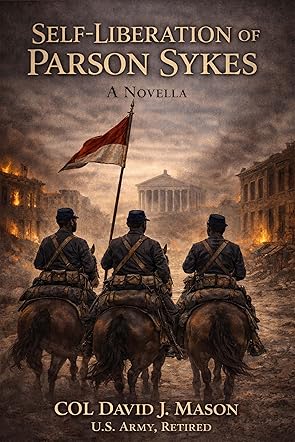
Self-Liberation of Parson Sykes by David J. Mason is a historical novella that traces one young man’s path from enslavement in Southampton County, Virginia, to the uncertain promise of freedom during the Civil War’s final years. Parson Sykes begins as a skilled laborer on Jacob Williams’s farm, where he quietly absorbs scraps of information from newspapers and abolitionist writings, including Frederick Douglass’s North Star. These forbidden words awaken in him the understanding that freedom will not simply arrive but must be claimed through action. As war draws closer and discipline tightens, Parson and his brothers resist in small but meaningful ways, holding onto dignity and faith even under constant threat. By late 1864, Parson makes the dangerous decision to escape eastward toward Union lines, risking capture and violence at every step.
David J. Mason’s writing blends documentary grounding with a dramatic narrative voice, moving between historical detail and intimate moments of reflection. The pacing is steady, structured around the clear arc of escape, enlistment, and the first steps into soldier citizenship. Scenes of quiet conversation with his family and fellow recruits balance the larger sweep of battles and political transformation, giving the novella both immediacy and scope. The prose often has a solemn intensity, emphasizing the emotional stakes of Parson’s choices while also placing his life within the broader history of Black self-determination. Readers who enjoy Civil War-era fiction rooted in research won’t want to miss Self-Liberation of Parson Sykes. The novella works especially well for those drawn to character-driven narratives that connect personal struggle with the larger, unfinished story of freedom in America.