






This author participates in the Readers' Favorite Free Book Program, which is open to all readers and is completely free. The author will provide you with a free copy of their book in exchange for an honest review. You and the author will discuss what sites you will post your review to and what kind of copy of the book you would like to receive (eBook, PDF, Word, paperback, etc.). To begin, click the purple email icon to send this author a private email.
This author participates in the Readers' Favorite Book Review Exchange Program, which is open to all authors and is completely free. Simply put, you agree to provide an honest review an author's book in exchange for the author doing the same for you. What sites your reviews are posted on (B&N, Amazon, etc.) and whether you send digital (eBook, PDF, Word, etc.) or hard copies of your books to each other for review is up to you. To begin, click the purple email icon to send this author a private email, and be sure to describe your book or include a link to your Readers' Favorite review page or Amazon page.
This author participates in the Readers' Favorite Book Donation Program, which was created to help nonprofit and charitable organizations (schools, libraries, convalescent homes, soldier donation programs, etc.) by providing them with free books and to help authors garner more exposure for their work. This author is willing to donate free copies of their book in exchange for reviews (if circumstances allow) and the knowledge that their book is being read and enjoyed. To begin, click the purple email icon to send this author a private email. Be sure to tell the author who you are, what organization you are with, how many books you need, how they will be used, and the number of reviews, if any, you would be able to provide.
Reviewed by Robert A. Groves for Readers' Favorite
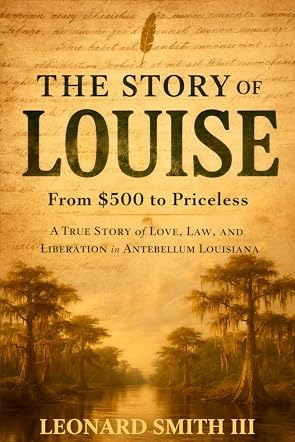
The Story of Louise: From $500 to Priceless by Leonard Smith III is a factual genealogical account of a black woman freed from slavery before it became a Civil War-era issue. She is first documented in the residence of Michel Richard in St. James Parish, Louisiana. At the age of twelve or thirteen, on May 8, 1833, Louise was sold for $500 to Francisco Placencia. Francisco became both her enslaver and, later, the father of her children. The law of the time did not allow Francisco to acknowledge his paternity in official records legally. Before he died in 1842, Francisco dictated three wills, each more explicit than the last, expressing his wish to free Louise and their children and to provide for them financially. After his death, an 11-year legal battle ensued as some of Francisco's heirs contested the wills. On March 31, 1853, Judge David A. Randall ruled that Louise and her children were to be freed and entitled to inheritances as specified in Francisco's wills. It took another five years and additional court proceedings to secure their legal rights.
Louise’s story from slavery to freedom represents the broader African American experience in the first decades of the United States’ history. Her third great-grandson, Leonard Smith III, has researched the story for nearly 50 years. His attention to detail is evident from beginning to end. His use of primary sources such as census records, church registers, court documents, and wills has created a remarkable piece of history that might otherwise have been lost to time. Structuring Louise’s story as a narrative rather than a list of dates and events that one finds in most family histories was an expert decision. The context of the era she lived in is woven into her story through this structure. Additionally, it is an honest recording of history. Smith acknowledges where gaps exist in the facts, and every data point included is traceable to documentation. The Story of Louise is simply astounding. Expect to be moved, informed, and inspired to explore your own roots.